How Long Does Suboxone Stay in Your System?
Suboxone is built to last. The buprenorphine in it leaves the body far more slowly than most opioid medications, which is why one dose covers a full day and why it can still be found in a urine test about a week after the last dose. Below is how long Suboxone stays in your system, what drug tests look for it, and what changes the timeline.
Medically reviewed by Dr. Gibran Guardado, Medical Director
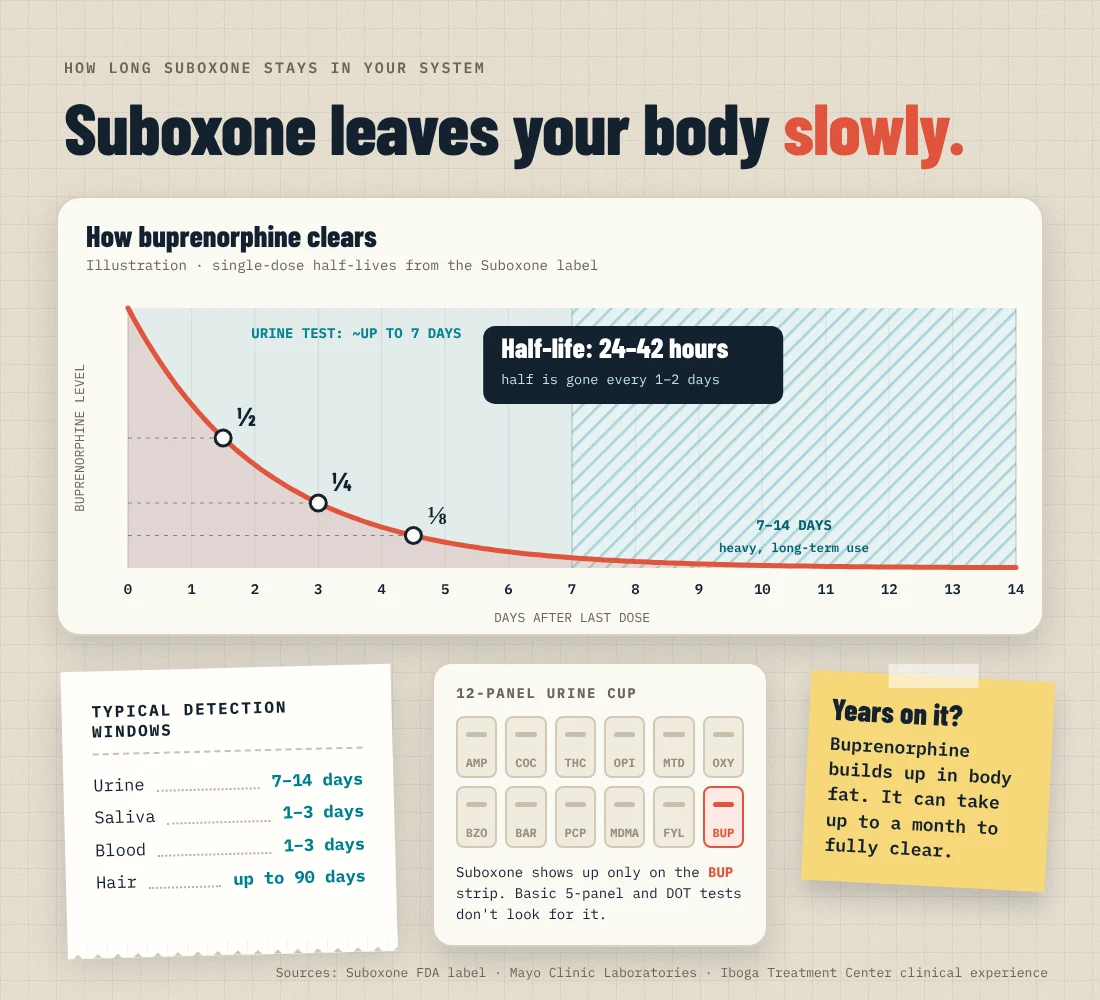
How Long Suboxone Stays in Your System
For most people, buprenorphine stays in the body for about a week after the last dose, and longer after years of daily use. Here is the typical range by test:
- Urine: up to about 7 days after the last dose, sometimes 7 to 14 days after long-term, higher-dose use
- Saliva: about 1 to 3 days
- Blood: about 1 to 3 days
- Hair: up to 90 days
These are averages, not promises. Mayo Clinic Laboratories notes that how long buprenorphine can be found depends on the dose, how often it was taken and how fast your body breaks it down.
Suboxone Half-Life: Why It Lingers
Suboxone contains two drugs. According to the FDA prescribing label, buprenorphine has a mean elimination half-life of about 24 to 42 hours, while naloxone clears much faster, in about 2 to 12 hours. Naloxone is there to discourage misuse, so it is the buprenorphine that matters for testing and for how long the medication stays in your system.
A half-life is the time it takes for the level in your blood to drop by half. It usually takes four to five half-lives for a drug to be mostly gone, which for buprenorphine works out to roughly five to nine days after a single dose. Your liver breaks buprenorphine down into norbuprenorphine, and many tests look for both. Most of it leaves the body through stool, with the rest passing in urine.
Does Suboxone Show Up on a Drug Test?
Only if the test looks for it. Buprenorphine is chemically different from morphine and heroin, so a standard opiate screen usually does not pick it up. Here is how common panels compare:
- 5-panel and DOT tests: do not include buprenorphine
- 10-panel tests: usually do not, unless buprenorphine has been added
- 12-panel and larger tests: often include a buprenorphine (BUP) strip
- Treatment program tests: almost always check for buprenorphine, and some also check for naloxone
Suboxone should not make you test positive for heroin, oxycodone, methadone or fentanyl. A positive screen is usually confirmed in a lab with a more precise method such as LC-MS/MS, which can tell buprenorphine apart from other substances.
How Long Does Suboxone Stay in Urine?
Urine tests are the most common way buprenorphine is checked. Mayo Clinic Laboratories states that finding buprenorphine or norbuprenorphine in urine points to use within about the past 7 days. For people who have taken Suboxone daily for months or years, especially at higher doses, a urine test can stay positive for 7 to 14 days after stopping.
Drinking extra water, detox drinks and exercise do not meaningfully speed this up, and diluted samples are often flagged and retested. If you take Suboxone as prescribed, the honest route is the best one: a positive result is expected, and your prescription explains it.
What Affects How Long Suboxone Stays in Your System
Two people who stop on the same day can clear Suboxone on very different timelines. The main factors are:
- Dose: higher daily doses take longer to clear
- How long you have taken it: after months or years, buprenorphine builds up in body tissue and releases slowly
- Liver health: the liver does most of the work, so liver disease slows clearance
- Other medications: some drugs that slow the liver enzyme CYP3A4 can raise buprenorphine levels
- Body fat, age and metabolism: buprenorphine is fat-soluble, so these all play a part
In our experience, when someone has been on Suboxone for a long time and it is deep in their system, it can take up to a month for it to fully clear.
What About Sublocade and Brixadi?
Monthly buprenorphine injections such as Sublocade are designed to release slowly for weeks. Clinical guidance notes that once levels are steady, buprenorphine from Sublocade may be detectable for 12 months or longer after the last shot, and blood levels can stay meaningful for at least two months. If you have had an injection, tell any tester and any treatment provider, including us, because it changes the timeline a great deal.
Why You Shouldn't Stop Suboxone on Your Own
Suboxone is an FDA-approved medication that keeps many people alive, and it is not something to quit abruptly to pass a test or to get ready for treatment. Because buprenorphine clears slowly, withdrawal often starts a day or more after the last dose and can drag on. Stopping suddenly also lowers your tolerance, which raises the risk of overdose if you use other opioids.
If you want to come off, talk with your prescriber or a treatment team first. We cover what coming off looks like, and how we handle withdrawal, on our page about getting off Suboxone with ibogaine.
Why Buprenorphine Has to Clear Before Ibogaine
How long Suboxone stays in your system matters a lot if you are considering ibogaine. Buprenorphine grips opioid receptors so strongly that it can block or blunt other medicines, so it needs to be out of the body before an ibogaine session can be both safe and effective.
That is why we never ask guests to stop on their own at Iboga Treatment Center. You arrive on your current dose, and under physician supervision we move you onto a shorter-acting opioid and keep you there until the buprenorphine has cleared. For some guests that stabilization lasts up to a month. Our doctors decide when you are ready based on how you are doing, not a set date, which is why ibogaine treatment for Suboxone stays usually run four to six weeks. The same long-acting problem applies to ibogaine treatment for methadone, while people coming off fentanyl or other opiates face their own preparation steps.
If You're Facing a Drug Test While on Suboxone
If you are prescribed Suboxone, you have nothing to hide. A few practical steps help:
- Keep a copy of your prescription or a letter from your prescriber
- Tell the collector or medical review officer that you take buprenorphine
- Ask what panel is being used if you are unsure whether it includes BUP
- Ask for a confirmation test if a result doesn’t match what you have taken
Other substances have their own windows. Kratom, for example, often isn’t on standard panels either, which we explain in does kratom show up on a drug test. And if you are weighing ibogaine, our honest look at the ibogaine success rate explains why the weeks around the dose matter as much as the dose itself.
How Long Suboxone Stays in Your System: FAQ
Quick answers about Suboxone half-life, drug tests and detox.
How long does Suboxone stay in your system?
For most people, buprenorphine can be found for about a week after the last dose. Urine tests are usually positive for up to 7 days, and for 7 to 14 days after long-term, higher-dose use. Saliva and blood tests have shorter windows of about 1 to 3 days, and hair tests can show use for up to 90 days.
What is the half-life of Suboxone?
The FDA label lists a mean half-life of about 24 to 42 hours for buprenorphine and 2 to 12 hours for naloxone. Because it takes four to five half-lives for a drug to be mostly gone, buprenorphine usually takes about five to nine days to leave the body after a single dose.
Does Suboxone show up on a drug test?
Only on tests that look for buprenorphine. Standard 5-panel and DOT tests do not include it, most 10-panel tests do not, and many 12-panel and treatment program tests do. It does not usually trigger a positive result for opiates such as heroin or morphine.
Will Suboxone show up on a 5-panel or 10-panel test?
A 5-panel test does not check for buprenorphine. A 10-panel test usually doesn’t either, unless the employer or lab has added it. If you are unsure, you can ask which panel is being used.
How long does Suboxone stay in your urine?
Mayo Clinic Laboratories says buprenorphine in urine points to use within about the past 7 days. After months or years of daily use, urine tests can stay positive for up to 14 days.
Can Suboxone cause a false positive for opiates?
It shouldn’t. Buprenorphine is chemically different from morphine, so it isn’t picked up by a standard opiate screen. Rarely, other medications cause a false positive on a buprenorphine strip, which a lab confirmation test can sort out.
How long does Sublocade stay in your system?
Much longer than Suboxone. Sublocade releases buprenorphine slowly over weeks, and once levels are steady it may be detectable for 12 months or longer after the last injection.
Do I need to be off Suboxone before ibogaine?
Buprenorphine has to clear before ibogaine, but you should not stop on your own. At our center you arrive on your current dose, and our doctors move you to a shorter-acting opioid and stabilize you, sometimes for up to a month, before the ibogaine session.
Thinking About Getting Off Suboxone?
Our admissions team can walk you through how stabilization works and how long your stay would likely be, privately and with no pressure. Learn more about our medically supervised ibogaine detox in Mexico. Before you call, you can also review how much ibogaine treatment costs.
Rather talk it over? Call (877) 876-4157 any time, day or night. Your call is confidential.