ALCOHOL ADDICTION TREATMENT
Ibogaine Treatment for Alcohol Addiction
Quitting heavy drinking on your own can be dangerous. At Iboga Treatment Center, you detox safely under a doctor’s care first, then receive ibogaine when your medical team says your body is ready, with the time and support to make the change last.
THE ALCOHOL TRAP
Why Alcohol Is Hard to Quit
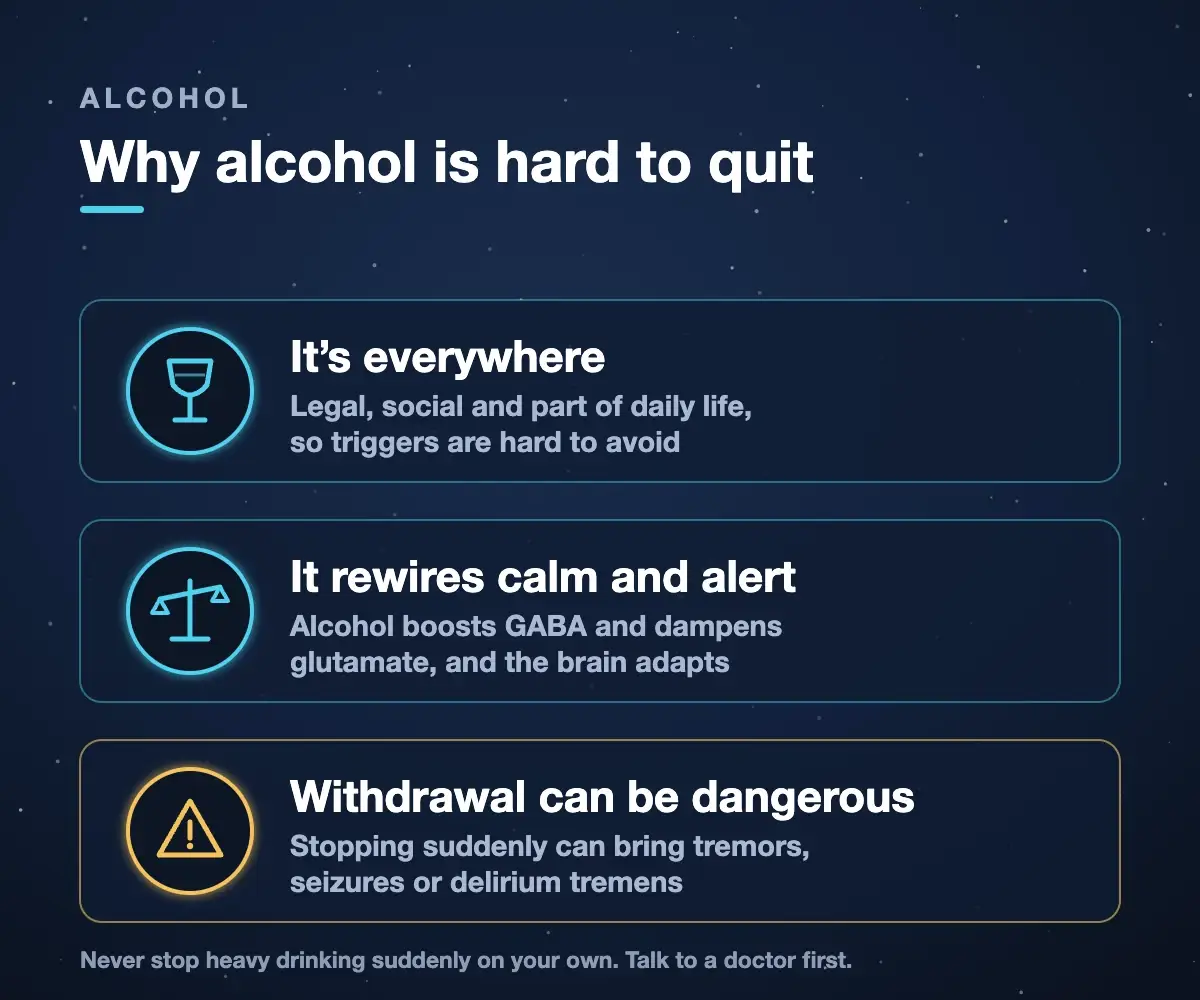
Alcohol is one of the most socially accepted and widely available addictive substances in the world, which makes it one of the hardest to quit. Unlike illegal drugs, it’s everywhere: at dinner, at work events, at family gatherings. That constant exposure can make recovery feel impossible, even for people who desperately want to stop.
Over time, heavy drinking rewires the brain. Alcohol boosts GABA, the brain’s calming signal, and dampens glutamate, its main excitatory signal. The brain adapts by turning GABA down and glutamate up, so when you stop drinking, your nervous system is left overexcited. That’s why alcohol withdrawal can be dangerous, with symptoms ranging from anxiety and tremors to seizures and delirium tremens.
Traditional programs rely on talk therapy, group sessions and sometimes medication to manage cravings, and those tools help many people. For others, relapse follows because the physical dependency and the patterns behind it were never addressed together. That’s the gap Iboga Treatment Center was built to close. Our ibogaine addiction treatment in Ensenada, Mexico pairs a doctor-supervised alcohol detox with ibogaine and extended residential support, so both are treated.
HOW IBOGAINE HELPS
How Ibogaine Treats Alcohol Addiction
Ibogaine works differently from the tools most alcohol programs rely on. It acts on several brain systems involved in reward, craving and mood, including dopamine, serotonin and opioid receptors. In a 2005 study in rats, ibogaine reduced alcohol drinking, partly by raising GDNF, a growth factor in the brain’s reward area. Guests commonly tell us their urge to drink is far weaker in the days and weeks that follow. Research in people is still early, and individual results vary.
An ibogaine session also brings an intense introspective experience that typically lasts 24 to 36 hours. Guests often describe gaining perspective on the emotional patterns and life circumstances behind their drinking. That insight is a starting point, not a cure, and our counselors work with each guest to make sense of it in the days that follow.
The body breaks ibogaine down into noribogaine, which stays active for several days after the session. Many guests describe steadier mood and fewer cravings during this period. Here’s more on how ibogaine works.

WHY TIME MATTERS
Detox Comes First. We Never Rush It.
Alcohol withdrawal can be dangerous, so if you’re still drinking, you detox here first under a doctor’s care. How long that takes depends on your body, how much you’ve been drinking and your liver numbers, and sometimes getting ready takes weeks. Not all ibogaine treatment centers are set up for that. Ours was built for longer stays, so we take the time your body needs, before ibogaine and after it.
Alcohol Withdrawal Timeline, With and Without Ibogaine
Alcohol withdrawal on its own can be dangerous, and for many people the hardest part comes after the first week. Here’s the usual pattern of alcohol withdrawal, and how we handle it instead.
Without Ibogaine
On your own
Hours 6–24
Early withdrawal begins: anxiety, shakiness, sweating, nausea and trouble sleeping.
Days 1–3
The riskiest stretch. Hallucinations, seizures and delirium tremens are possible, which is why medical supervision matters most here.
Days 4–7
Physical symptoms usually ease, but cravings, low mood and anxiety can stay strong.
Weeks 2–8
Sleep problems, mood swings and cravings come in waves. This is when many people go back to drinking.
Months 3–12+
Post-acute withdrawal (PAWS): waves of anxiety, low mood and cravings that can last a year or longer.
Alcohol Detox and Ibogaine With Us
Our approach
First days
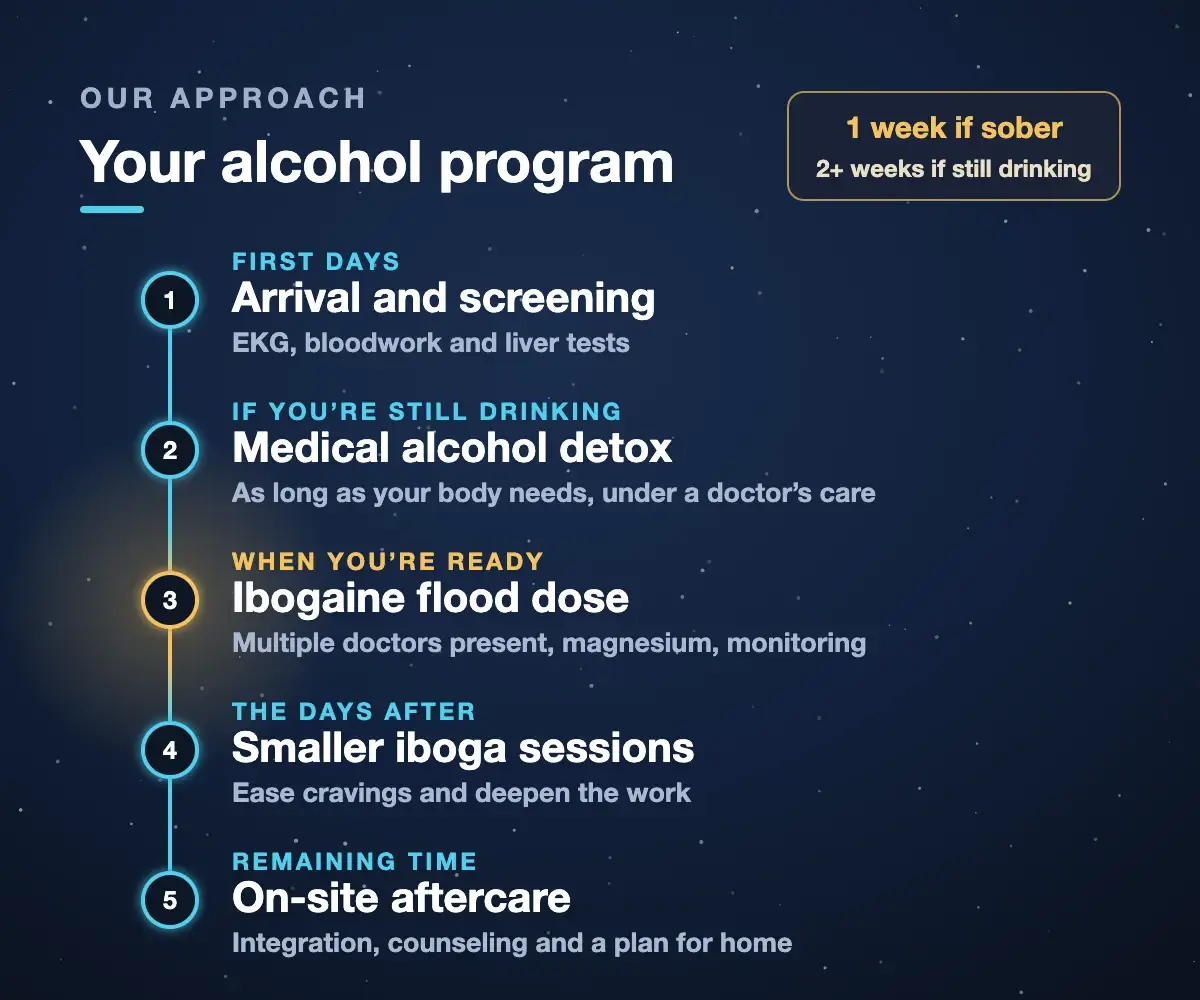
Arrival and screening: an EKG, bloodwork, liver function tests and a full medical history.
Medical detox
If you’re still drinking, your doctor manages withdrawal, with medication when needed and medical staff on site 24/7. How long it takes depends on your body, how much you’ve been drinking and your liver numbers.
When you’re ready
A single ibogaine flood dose, with several doctors present, magnesium given too, and 24 to 36 hours of cardiac monitoring.
The days after
Smaller iboga sessions ease lingering cravings while noribogaine supports steadier mood.
Remaining time
Integration therapy, daily counseling with licensed counselors and residential support.
When you leave
A personalized aftercare plan, and extended aftercare with supervised housing if you need more time.
Timelines are typical ranges and vary from person to person. Your medical team sets your schedule.
HOW TO QUIT DRINKING
How to Quit Drinking Safely
If you drink heavily every day, stopping suddenly on your own can be dangerous. Seizures and delirium tremens are uncommon but serious, and they’re the reason alcohol detox should happen under medical care. Talk to a doctor before you stop.
Our approach: if you’re still drinking, you detox here first, under a doctor’s care, with your heart and liver checked along the way. When your medical team says you’re ready, you receive ibogaine with multiple doctors present and continuous cardiac monitoring, followed by smaller iboga sessions and on-site aftercare to fully finish the treatment.
If you take naltrexone, acamprosate, Antabuse (disulfiram) or any other medication, don’t stop it on your own. Our medical team reviews everything you take during screening and tells you exactly how to prepare.
How Long Is an Alcohol Program?
1 week
If you arrive already sober, decided case by case
2+ weeks
If you’re still drinking, with detox first
+ Aftercare
Extended aftercare with supervised housing if you need it
Everyone is different. How long detox takes depends on your body, how much you’ve been drinking and your liver numbers, so your medical team sets your schedule. Compare our ibogaine treatment programs.
The Iboga Treatment Center Alcohol Protocol
Medical Detox
If you’re still drinking, your stay begins with a medically supervised alcohol detox. A doctor oversees your withdrawal and uses medication when it’s needed, and medical help is available at any hour. Liver health matters for ibogaine, so liver function tests are part of your screening and your numbers are watched throughout. Every detox is case by case, and we never rush it.
The Ibogaine Session
When the medical team is satisfied you’re stable, you receive the flood dose in a clinical room, with your heart monitored the entire time. Doctors are with you throughout, magnesium is given alongside the ibogaine, and the medical team stays by your side for the full 24 to 36 hours. Our three medical doctors guide your treatment.
Post-Flood Iboga Work
After the flood dose, smaller iboga sessions help ease remaining cravings and support the emotional work. This phase matters for alcohol guests, because drinking is often tied to emotional patterns and past experiences that take time to process.
Integration and Aftercare
Our licensed counselors work with you daily. Between sessions, you’ll have our temazcal sweat lodge, saltwater pool, outdoor meditation spaces and a close-knit community of people who understand what you’re going through. Ahead of your departure, you and your counselor shape an aftercare plan, and you can stay on in supervised housing if you need it.
GUEST STORY
Lance’s Story
“I was drinking a gallon of vodka a day. I couldn’t go more than a few hours without a drink or my hands would start shaking. I’d been to two rehabs and nothing changed — I’d be sober for a couple weeks and right back at it.
My month at Iboga Treatment Center was the first time I actually understood what was driving me to drink. The ibogaine was unlike anything I’ve ever experienced — it was like seeing my life from the outside for the first time.
But it was the weeks after that really saved me. The counseling, the community, the daily support — and then the iboga later in my stay really hammered it all home. Everything clicked. I’m sober now and I don’t white-knuckle it every day like I did after rehab. The urge is just gone and life has become amazing.”
Individual results vary. Read what other guests say on our testimonials page.
Alcohol and Ibogaine: Your Questions Answered
Is ibogaine safe for people with alcohol dependency?
Ibogaine carries real medical risks, and alcohol adds two of its own. Heavy drinking can strain the liver, which is the organ that processes ibogaine, and alcohol withdrawal itself can be dangerous. So every alcohol guest has an EKG, bloodwork and liver tests, and anyone still drinking goes through a supervised detox before ibogaine is even considered. On treatment day, you have more than one doctor present, magnesium alongside the ibogaine and continuous monitoring. Nothing in medicine is risk-free, and if ibogaine isn’t right for you, we’ll say so directly.
Do I need to be sober before I come to the clinic?
No, and please don’t try to stop drinking on your own before you arrive. Suddenly stopping after heavy, long-term drinking can cause seizures and other serious complications. Drink as you usually do until our medical team gives you specific instructions for the days before you travel. Your alcohol detox happens here, under a doctor’s care. If you’re already sober when you arrive, your program can be shorter.
What about delirium tremens or seizures during withdrawal?
These are the most serious risks of alcohol withdrawal, and they’re the reason we detox every guest who is still drinking on site before ibogaine. During detox, our medical staff monitors your vital signs and symptoms around the clock and treats withdrawal with medication when needed. Ibogaine is only given after your body has stabilized.
Can I detox from alcohol at home?
If you drink heavily every day, detoxing alone at home can be dangerous. Seizures and delirium tremens can develop in the first few days, sometimes with little warning. Talk to a doctor before you stop drinking. At Iboga Treatment Center, detox happens on site under a doctor’s care, with medical staff on site 24/7.
How long does alcohol withdrawal last?
Without treatment, alcohol withdrawal usually starts 6 to 24 hours after the last drink, is most intense over the next one to three days and eases within about a week. Some people have lingering symptoms, such as poor sleep, low mood and cravings, for weeks or months afterward. In our program, withdrawal is managed medically, and how long your detox takes depends on your body, how much you’ve been drinking and your liver numbers.
Will my liver be a problem for ibogaine treatment?
It might be, which is why we check. Liver function tests are part of every alcohol guest’s screening, and our team monitors your liver throughout your stay. Mild elevation is common in heavy drinkers and often improves once drinking stops, so sometimes we wait for your numbers to improve before ibogaine. Significant liver damage can rule ibogaine out. Your results are reviewed by our medical team before any decision is made.
How long should I stay for alcohol treatment?
If you arrive already sober, the program can be as short as one week, decided case by case. If you’re still drinking, plan on at least two weeks, because detox comes first, and sometimes getting ready takes several weeks. With daily or long-term drinking, more time usually helps: four weeks is the program we recommend most, and supervised housing through extended aftercare is available after that. See all of our program options.
Will ibogaine stop my cravings to drink?
In the weeks after treatment, guests often notice their cravings have faded a great deal, and some say the way they think about drinking has changed. Research on ibogaine for alcohol dependency is still early, and we can’t promise a specific result. What we can do is combine treatment with counseling, integration and time, so the change you feel has a chance to last. Individual results vary.
I’ve tried rehab and AA. Why would ibogaine be different?
Rehab and AA help many people, and if they’re working for you, keep going. Guests come to us when the physical pull of alcohol keeps overriding everything they’ve learned. Ibogaine is a different kind of tool: it acts on brain systems involved in craving and mood, and our extended stay adds counseling, integration and aftercare planning on top of it. It isn’t a replacement for the recovery work you’ve done, and many guests return to their support groups afterward with a different footing.
Should I stop taking naltrexone, Antabuse or other medications before treatment?
No. Keep taking your medications unless our medical team tells you otherwise. Some medications interact with ibogaine and need to be managed carefully, but stopping them suddenly can also be harmful. Share a complete list with admissions, supplements too, and you’ll get instructions from our doctors during screening. If you take benzodiazepines, a doctor decides how to manage them for you individually.
What happens when my stay ends?
You leave with a personalized aftercare plan built with your counselor, which may include therapy and support groups at home. If you’re not ready to go home yet, extended aftercare with supervised housing is available. See our aftercare program for details.
How much does alcohol treatment cost?
How long you stay, your medical needs and the length of your detox all shape the cost. Admissions reviews pricing with you after screening. General information is on our ibogaine treatment cost page.
Is the clinic easy to reach from the US?
It is. We’re in Ensenada, Baja California, around two hours’ drive from San Diego. Fly into San Diego, and our team takes it from there, picking you up at the airport and driving you across the border. Admissions can help with flights, timing and your packing list. Since ibogaine is a Schedule I substance in the US, treatment there isn’t legal, and that’s the reason we operate in Mexico.
Still have questions? Call admissions at (877) 876-4157.
When Drinking Isn’t the Only Struggle
Heavy drinking and depression often go together. See how we use ibogaine for treatment-resistant depression.
Many people drink to quiet anxiety. Learn how our ibogaine program for anxiety works.
Alcohol and cocaine are often used together. See how ibogaine treatment works for cocaine addiction.
Also dealing with something besides alcohol? Our ibogaine addiction treatment page lists all the substances we treat.
Ready to Quit Drinking for Good?
Reach out today for a free, private consultation about alcohol treatment. No one will push you; we’ll simply answer your questions honestly.
Questions About Quitting Drinking?
Talk With Us About Alcohol Treatment
Stopping alcohol safely takes planning, and it is normal to wonder about detox, your liver or how long a stay might run. Send us your number and someone from admissions will call to help you sort it out, for yourself or for a family member.
- Whether you need medical detox before ibogaine
- How stay length changes if you are still drinking
- How your current medications are handled
Need to talk today? Call (877) 876-4157
Have Admissions Call You
Fill in each field below. It’s quick.