Ibogaine Success Rate: Why One Dose Isn’t the Answer
Ibogaine can stop withdrawal in its tracks. Staying free is harder. Here’s what the studies really show, and why the process around the dose matters most.
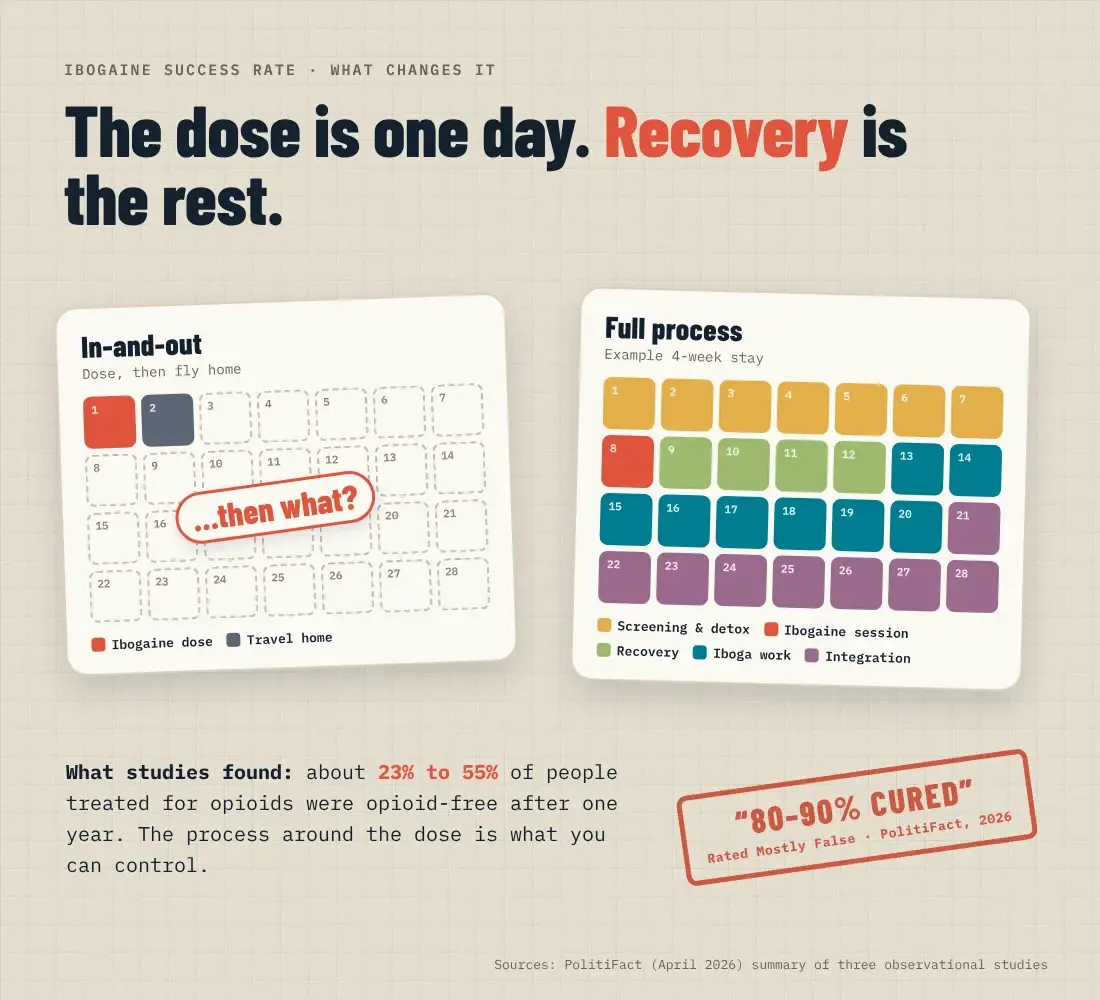
It Depends on What Happens Before and After the Dose
There isn’t one ibogaine success rate. The small studies that followed people for a year found that roughly 23% to 55% were no longer using opioids at the one-year mark. That’s a real result for people who had often tried everything else, but it’s nowhere near the 80% or 90% you may have seen advertised.
The studies also point to something important. Ibogaine is very good at one thing: interrupting withdrawal. Whether that turns into lasting recovery depends heavily on what surrounds the dose, including preparation, safe detox, recovery time, integration and support afterward.
At Iboga Treatment Center, that’s the belief our program is built on. As part of a larger process, ibogaine can be a game changer. A quick, in-and-out dose is not the answer.
What Studies Say About Ibogaine Success Rates
No large, controlled trial of ibogaine for addiction has been completed yet. What exists are a few observational studies that tracked people after treatment at clinics. Here’s what three of the most cited ones found, as summarized by PolitiFact’s April 2026 fact-check:
| Study | Who was followed | What they found |
|---|---|---|
| Mexico clinic study (Brown and Alper) | 30 people treated for opioid dependence | 50% opioid-free at one month, 33% at three months and 23% at one year |
| New Zealand study (Noller and colleagues) | 14 people treated for opioid dependence | At 12 months, 55% of the 11 still in the study reported no opioid use in the past 30 days |
| Ohio State survey (Davis and colleagues) | 88 people treated at Mexico clinics, 2012 to 2015 | 80% said withdrawal was eliminated or greatly reduced; 30% never used opioids again |
All three are small, none had a comparison group, and most results came from people reporting on themselves. The researchers say so plainly. Larger, controlled studies are being planned in the United States, and our guide to ibogaine’s legal status explains where those stand.
Where the 80% and 90% Numbers Come From
You’ll find claims online that one ibogaine treatment frees 80% of people from opioid addiction, and two treatments free 90%. When PolitiFact checked that claim in April 2026, it rated it Mostly False and found no research to support it.
The likely source is a mix-up between two different results. In the Ohio State survey, 80% of people said ibogaine took away most or all of their withdrawal. Only 30% said they never used opioids again, and 70% reported a relapse at some point. Relief from withdrawal and long-term recovery are not the same thing.
If a clinic quotes you a success rate, ask how it was measured, over what period and how many people were followed. A number without those answers is a sales figure.
What Ibogaine Does Well: Interrupting Withdrawal
The most consistent finding across studies and clinics is that ibogaine can ease opioid withdrawal and cravings dramatically in the days after treatment. For someone who has been trapped by the fear of being sick, that break can feel like a door opening.
Part of the effect may come from noribogaine, which the liver produces from ibogaine and which lingers for days. Researchers are also looking at whether the brain stays more adaptable for a while after treatment. That work is promising, though much of it is still early or done in animals. Our page on how ibogaine works goes into the science.
What ibogaine can’t do is change the life someone goes home to. The habits, stress, relationships and triggers are still there, and that’s where a short stay leaves people on their own.
Why a Quick, In-and-Out Ibogaine Treatment Falls Short
Some clinics offer ibogaine as a weekend or a few days: arrive, take the dose, fly home. In our experience, that model sets many people up to struggle. Here’s why:
- Long-acting drugs need time first. Methadone, Suboxone and fentanyl stay in the body longer than short-acting opioids, so people usually need a medically managed transition before ibogaine is safe.
- The body needs time to recover. Ibogaine affects heart rhythm, and that effect can last for days after the dose. Leaving too soon means leaving while the body is still settling.
- Sleep and mood take time. Many people feel raw, tired or flat for a while after detox. That’s a hard time to be alone.
- The real work comes after. Making sense of the experience and planning for home is where lasting change gets built.
A short stay can still interrupt withdrawal. It just leaves out most of what helps the change last.
What a Full Ibogaine Treatment Process Looks Like
Our ibogaine treatment programs are built around the dose rather than around it alone. A stay moves through these stages:
- Screening before you arrive, including an EKG, bloodwork and a full medication review. Our post on how we prepare you walks through it.
- Stabilization and detox, under medical supervision, for as long as your body needs.
- The ibogaine session, with more than one of our three doctors present, magnesium for heart protection and continuous monitoring.
- Rest and recovery in the days after, while our medical staff stay close by at all hours.
- Follow-up iboga work, using smaller doses where it helps.
- Integration, including one-on-one counseling with licensed counselors and a personalized plan for going home.
That’s why we recommend four weeks more often than any other length. It gives every stage enough room.
How Long Treatment Should Last for Your Substance
The right length depends mainly on what you’re coming off. These are the lengths our medical team usually recommends. Your exact plan is set after screening.
| Coming off | Usual recommended stay | Learn more |
|---|---|---|
| Fentanyl | Four weeks or longer | Ibogaine for fentanyl addiction |
| Methadone | Four weeks or longer | Ibogaine treatment for methadone |
| Suboxone | Four weeks or longer | Ibogaine treatment for Suboxone |
| Heroin and pill opioids | Two weeks minimum, four recommended | Ibogaine treatment for opioid addiction |
| Kratom and 7-OH | At least two weeks; often closer to a month | Kratom detox and treatment |
| Alcohol | One week if already sober; two or more if not | Ibogaine for alcohol addiction |
| Cocaine, meth or Adderall | Usually two to four weeks | Ibogaine for meth addiction |
A one-week stay is possible on a case-by-case basis for people who arrive already clean. For everyone else, the extra time isn’t an upsell. It’s the part of treatment that does the most to protect the result. You can compare lengths on our ibogaine treatment cost page.
What Happens After You Go Home
Leaving the clinic is a turning point, not a finish line. For guests who want more time before going home, our ibogaine aftercare program offers between two weeks and three months on its own dedicated property, with temazcal sweat lodge sessions usually once a week and further iboga work decided case by case.
Wherever you go next, a few things make a real difference: a therapist or counselor at home, people who know what you’re working on, a daily routine, and distance from the places and people tied to using.
One safety warning matters above all. After detox, your tolerance to opioids drops sharply. Using your old amount can cause a fatal overdose. Keep naloxone (Narcan) on hand and make sure someone close to you knows how to use it.
Questions to Ask Any Ibogaine Clinic About Success
If you’re choosing between ibogaine treatment centers, the way a clinic talks about success tells you a lot. Ask each one:
- What success rate do you claim, and how did you measure it?
- How long is the stay, and what happens before and after the dose?
- Are doctors present during the session, and how is my heart monitored?
- How do you handle long-acting drugs like methadone, Suboxone or fentanyl?
- What support is there after I leave?
A clinic that promises a cure in a few days is telling you what you want to hear. We’d rather tell you what we’ve learned from treating more than 500 guests since 2018: ibogaine works best as one part of a longer, well-supported process. If that sounds right to you, apply to see if you qualify.
Ibogaine Success Rate: Frequently Asked Questions
Straight answers to what people ask us about ibogaine and lasting results.
What is ibogaine’s success rate?
Small one-year studies of people treated for opioid dependence found that about 23% to 55% were no longer using opioids after a year. Results vary widely with the person, the substance and how much support surrounds the treatment.
Is ibogaine a cure for addiction?
No. Ibogaine can interrupt withdrawal and cravings, which gives people a real opening. Lasting recovery still takes preparation, recovery time, integration and support after treatment.
Can you relapse after ibogaine?
Yes. In one survey of 88 people treated at Mexico clinics, 70% reported using opioids again at some point after treatment. That’s why what happens after the dose matters so much.
Does one ibogaine treatment work?
One ibogaine session can greatly reduce withdrawal and cravings for many people. On its own, without preparation and aftercare, it often isn’t enough to keep someone off drugs long term.
Why do some clinics claim an 80% or 90% success rate?
PolitiFact found no research supporting those figures and rated the claim Mostly False in April 2026. The 80% likely comes from a survey in which 80% reported relief from withdrawal, which is different from staying off drugs.
How long should ibogaine treatment be?
It depends on what you’re coming off. We usually recommend four weeks or more for fentanyl, methadone and Suboxone, two to four weeks for most other substances, and one week only for people who arrive already clean.
Does aftercare improve ibogaine results?
There’s no head-to-head study yet. In our experience, guests who take the time to recover, integrate the experience and plan for home are in a much stronger position than those who leave right after the dose.
What makes ibogaine treatment more likely to last?
Enough time on site, medically safe detox, doctors present during the session, honest integration work, and a solid plan and support network at home. A quick dose skips most of those.
Looking for More Than a Quick Dose?
Our admissions team can talk through how long you’d need and what a full process would look like for you, privately and without pressure.
Prefer to ask a person directly? Call (877) 876-4157 to reach admissions at any hour. Everything you share stays private.