How Long Does Ketamine Stay in Your System?
Ketamine leaves the blood within about a day, but lab tests can find traces in urine for days and in hair for months. Here is the plain-language timeline.
Medically reviewed by Dr. Gibran Guardado, Medical Director
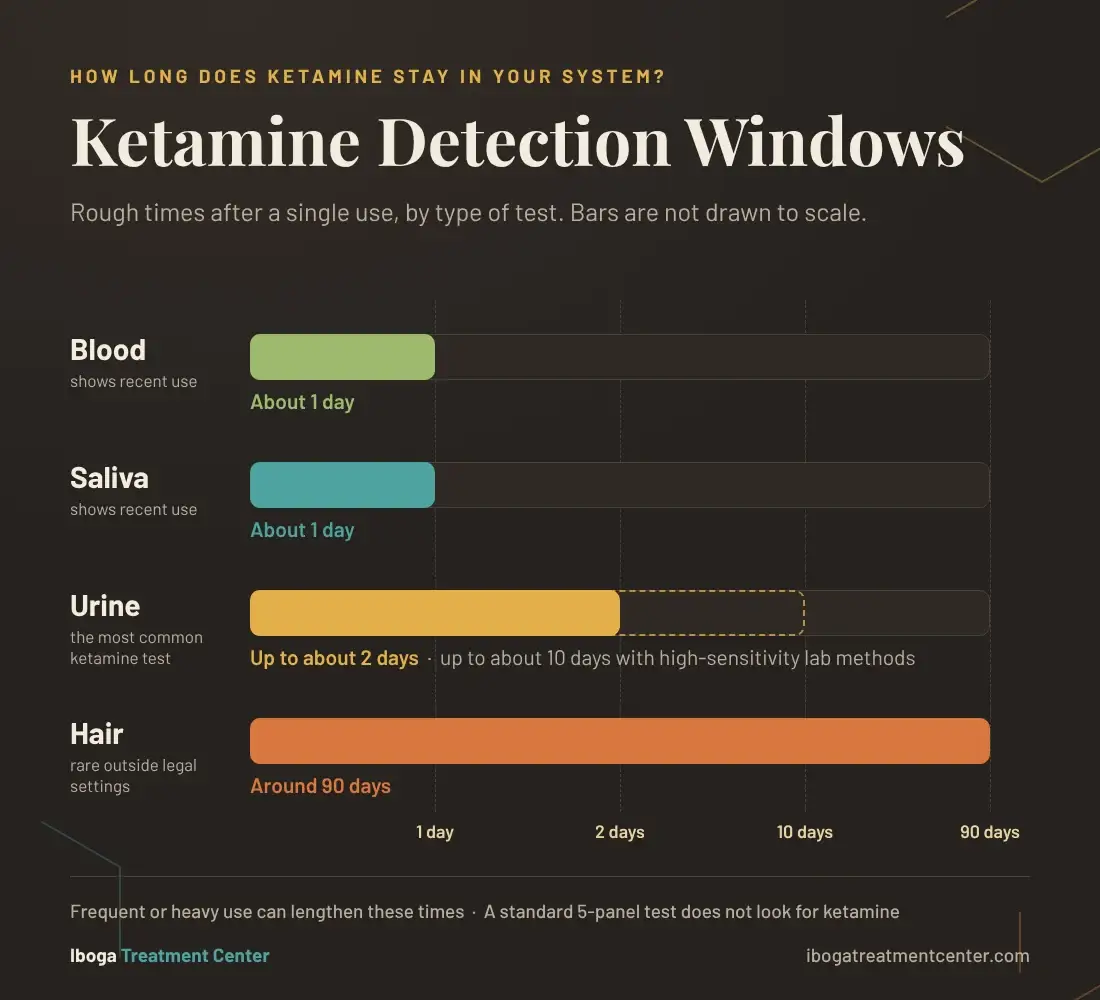
How Long Ketamine Stays in Your System
For most people, a single use of ketamine is out of the bloodstream in roughly a day. A urine test sent to a lab usually finds it for about two days, and very sensitive lab methods have picked up its breakdown products for up to ten days. Hair can hold a record for around three months.
Those numbers shift with how much someone takes, how often, and how well their liver and kidneys work. Daily or heavy use generally means a longer window than one-time use.
| Test | Rough detection window |
|---|---|
| Urine (standard lab cutoff) | Up to about 2 days |
| Urine (high-sensitivity lab methods) | Up to about 10 days |
| Blood | About 1 day |
| Saliva | About 1 day |
| Hair | Around 90 days |
Ketamine’s Half-Life, Explained Simply
A half-life is the time your body needs to clear half of a drug. Ketamine’s half-life is short, about two to three hours. After five half-lives a drug is mostly gone, which is why the ketamine itself is largely cleared from blood in under a day.
The story doesn’t end there. Your liver turns ketamine into other compounds, mainly norketamine and then dehydronorketamine. These leave more slowly, and they are what labs often look for. That is why a test can come back positive well after the effects have worn off.
Does Ketamine Show Up on a Drug Test?
Usually not on a standard one. The common 5-panel workplace test looks for marijuana, cocaine, opiates, amphetamines and PCP. Ketamine isn’t on that list, and most 10-panel tests leave it out as well.
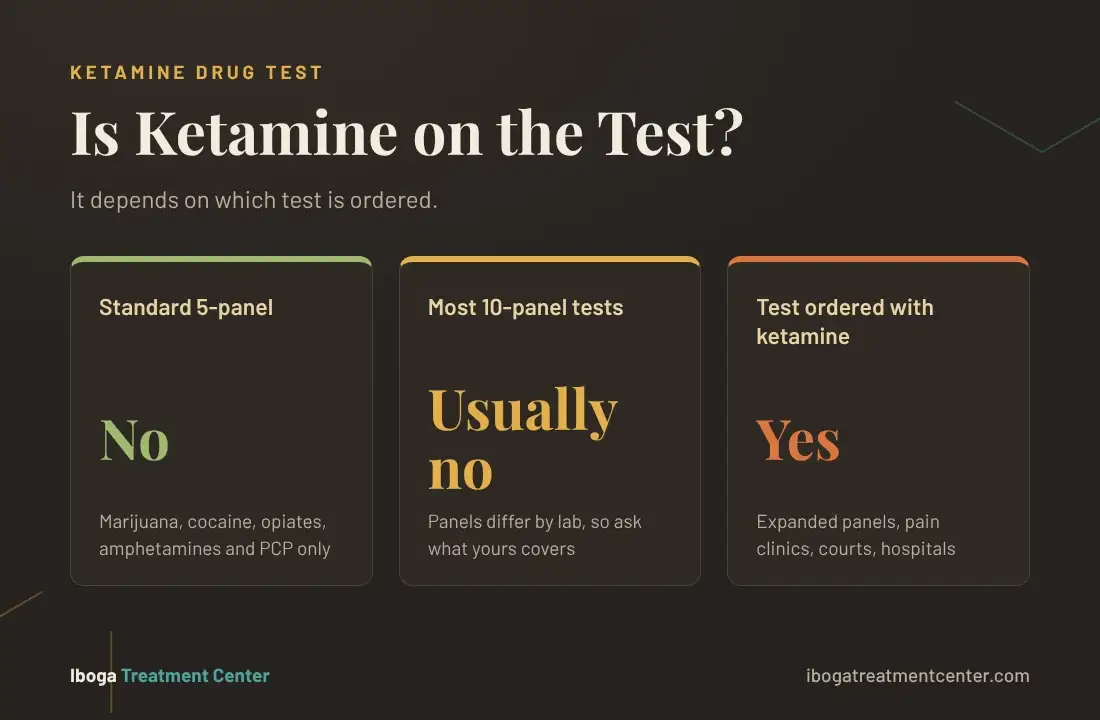
Ketamine shows up when someone orders a test that includes it. That can happen with:
- expanded panels used by some employers, courts and probation programs
- pain clinics and treatment programs
- hospital and forensic testing
If you don’t know what a test covers, you can ask which substances are on the panel.
Urine, Blood, Saliva and Hair
Urine. This is the most common ketamine test. At the cutoffs many labs use, ketamine and norketamine are found for up to about two days. In one study using far more sensitive equipment, ketamine was confirmed for up to five days, norketamine for six, and dehydronorketamine for ten after a single dose.
Blood. Blood shows recent use. Ketamine drops quickly, so blood tests are mostly used in hospitals and emergencies, within about a day of use.
Saliva. Saliva tests also show recent use, roughly the past day. Few saliva panels include ketamine.
Hair. Hair grows about half an inch a month and keeps a record as it grows. A standard sample covers around 90 days. Hair testing for ketamine is rare outside legal and forensic settings.
Why the Timing Is Different for Everyone
- How often you use. With frequent use, ketamine and its breakdown products build up, and the body needs longer to clear them.
- How much. Larger amounts take longer to leave.
- Liver and kidneys. The liver breaks ketamine down and the kidneys carry it out. If either is working poorly, clearance slows.
- Age, body size and metabolism. These all shift the timing a little.
- The test itself. A more sensitive test finds smaller traces for longer.
Nothing reliably speeds this up. Water, exercise and “detox” products don’t make the liver work faster. Time is what clears ketamine.
What If Your Ketamine Is Prescribed?
Ketamine and esketamine (Spravato) are used legally for anesthesia, pain and depression. If you are tested while receiving one of them, tell the person running the test and bring proof of the prescription. A lab can confirm ketamine, but it can’t tell whether it came from a clinic or somewhere else.
If you’re comparing options, our post on ibogaine vs ketamine explains how the two treatments differ.
When the Real Question Is How to Stop
Many people who look this up are worried about one test. Others are counting days because ketamine has become hard to put down. Using more to get the same effect, using alone, or bladder pain and constant trips to the bathroom are signs to take seriously.
Stopping is the first step toward healing, including for the bladder. You don’t have to do that part alone. We offer ibogaine treatment for ketamine addiction at our center in Mexico, where our doctor checks for bladder problems and treats them as part of the stay.
Ketamine and Ibogaine Treatment at Our Center
Iboga Treatment Center has cared for guests in Ensenada since 2018, and ketamine is one of the substances we see more of every year.
Before ibogaine, guests spend a predetermined amount of time off ketamine. That detox is done here with us, and it can be an emotional stretch. Ibogaine treatment then happens once our doctor approves it. Every situation is different, so a consultation decides how long the stay should be and what treatment looks like. Ketamine programs typically run two weeks and up.
Our medical team is on site 24/7, and an EKG and bloodwork come first for each guest. If you’re looking for an ibogaine detox center in Mexico, call (877) 876-4157 or apply online.

Ketamine in Your System: Common Questions
Short answers to the ketamine testing questions people send us most.
How long does ketamine stay in your urine?
At standard lab cutoffs, up to about two days after a single use. Sensitive lab methods have found its breakdown products for up to ten days. Frequent use can lengthen that.
Is ketamine on a 5-panel drug test?
It isn’t. A standard 5-panel test doesn’t look for ketamine. It only shows up if the test was ordered with ketamine included.
Do 10-panel or 12-panel tests check for ketamine?
Usually not. Panels vary by lab, though, and some expanded panels add ketamine. Ask what your test covers.
What is the half-life of ketamine?
About two to three hours. Its main breakdown product, norketamine, lasts longer, which is why tests can stay positive after the effects fade.
Can a hair test detect ketamine?
Yes. Hair can hold a record of ketamine for around 90 days. Hair tests for it are uncommon outside courts and forensic labs.
How long does a ketamine infusion stay in your system?
The same rules apply as for any ketamine: mostly out of the blood within a day, and traceable in urine for a few days. Bring your prescription or clinic paperwork if you are tested.
Does drinking water flush ketamine out faster?
No. Staying hydrated is good for you, but it doesn’t speed up how fast the liver breaks ketamine down.
How long do I need to be off ketamine before ibogaine treatment?
There is a set amount of time off ketamine first, and our doctor decides the details for each guest. We handle that detox at the center, so you don’t need to stop on your own before you arrive.
Ready to Put Ketamine Behind You?
Tell our admissions team what’s going on, and we’ll explain how a stay in Ensenada would work for you.
Rather talk now? Call (877) 876-4157, any hour. There’s no obligation in asking.