How Long Is Rehab? Detox, 30-Day and Long-Term Programs Explained
How long is rehab, really? Here’s how long detox, 30-day and longer programs usually last, why the length of a stay matters so much, and how to pick the right one.
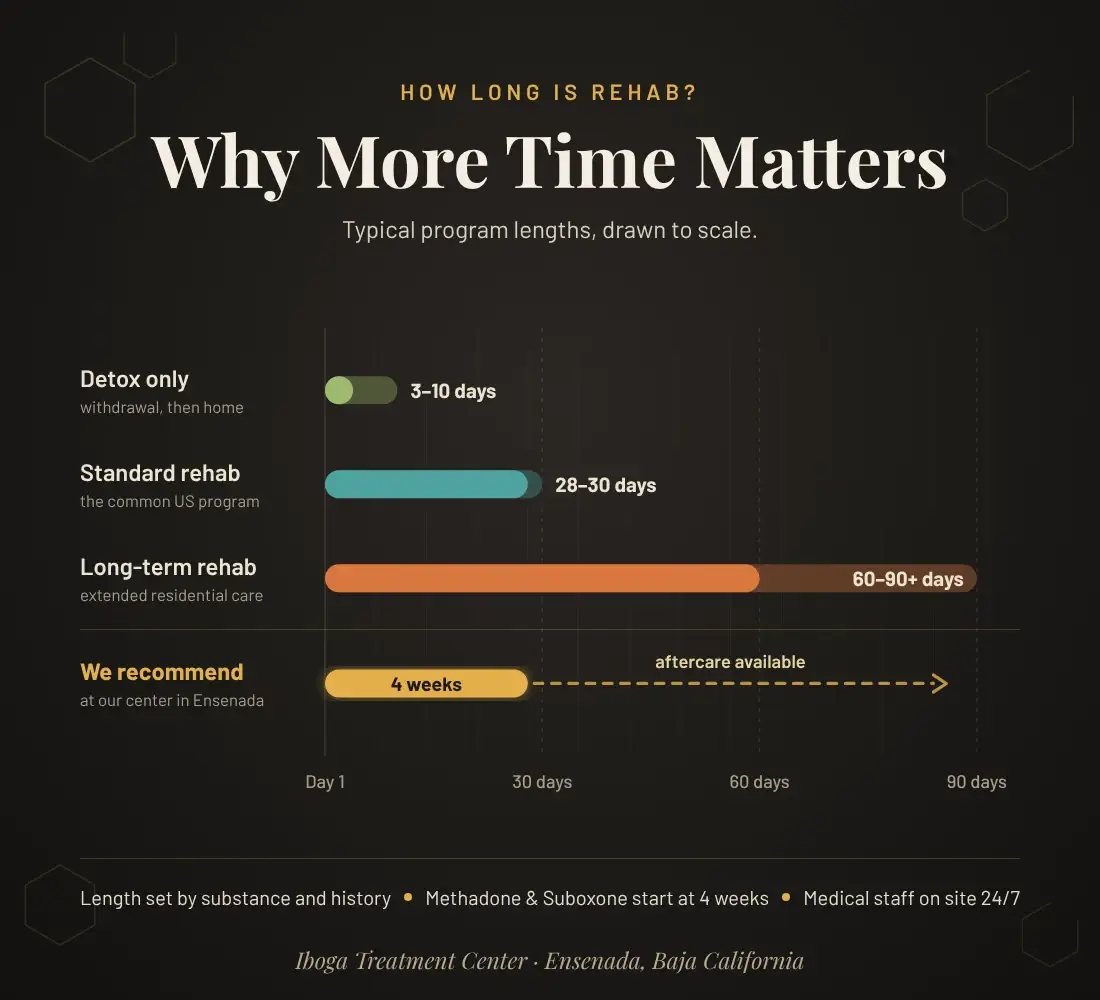
How Long Is Rehab, Usually?
It depends, but most programs fall into a few common lengths:
- Detox only: about 3 to 10 days. Just long enough to get through the worst of withdrawal.
- Standard rehab: 28 to 30 days. This is what most people picture when they hear “rehab.”
- Long-term rehab: 60 to 90 days or more, living on site the whole time.
- Outpatient: a few sessions a week for several weeks or months, while you keep living at home.
The right length comes down to what you’re using, how long you’ve been using it and what you’ve already tried. A lot of families searching for ibogaine treatment Mexico options ask us this exact question, because stays there can be anywhere from a few days to several weeks.
Why So Many Rehab Programs Last 28 or 30 Days
The 28-day program became the norm a long time ago, and a big reason it stuck is that insurance plans were set up to pay for about a month. It’s a convenient number. Nobody picked it because a month is how long it takes to get better.
Getting well doesn’t run on a calendar. Once the first rough days of withdrawal are over, things like sleep, mood, energy and cravings can take weeks or even months to even out, especially for someone who has used opioids for years. Leaving on day 28 can mean walking out right when things are hardest.
That doesn’t mean 30 days is a waste. For some people it’s a good start. It just works best when everyone treats it as the beginning, with a real plan for what happens next.
Does a Longer Rehab Stay Work Better?
The research points that way. The National Institute on Drug Abuse (NIDA), the federal agency that studies addiction, says staying in treatment long enough is one of the keys to it working. According to NIDA, most people need at least three months of treatment to really cut back or stop, and the best results tend to come with more time.
Two things to keep in mind. Those three months don’t all have to be spent living at a treatment center. Counseling, outpatient care and support after a stay all count. And NIDA is clear that detox by itself is only the first step, and on its own it doesn’t do much to keep someone from going back to using.
So instead of asking “What’s the shortest program we can do?”, it’s worth asking “What’s the whole plan, from day one through the months after?”
Detox vs Rehab: Why a Week Usually Isn’t Enough
Detox gets the drugs out of your body and gets you through withdrawal safely. That matters, but it doesn’t touch the stuff that keeps pulling you back: the habits, the stress, the people and the places.
That’s why so many people end up going through detox over and over. They come out physically clean, go right back to the same life, and nothing has really changed. Families often tell us about a son, daughter or spouse who has been through detox three, four, even five times.
A longer stay gives you room to breathe. Time to sleep through the night again, eat real meals, talk things through with a counselor and get used to a new routine while you’re still somewhere safe. That’s when the real work starts.
How Long Rehab Takes for Different Substances
Some drugs take a lot longer to come off than others. Here’s where stays usually start at our center in Ensenada, and what we tend to recommend:
| Substance | Where a stay usually starts | What we usually recommend |
|---|---|---|
| Fentanyl | About 2 weeks to get stable before ibogaine | 4 weeks or longer |
| Heroin and opioid pills | 2 weeks | 4 weeks |
| Methadone | 4 weeks | Many stay 6 weeks, and many go on to aftercare |
| Suboxone | 4 weeks | Some need 6 weeks |
| 7-OH and kratom | 2 weeks | Many need up to a month |
| Alcohol | 1 week if you’ve already stopped drinking, 2 weeks or more if you haven’t | Decided case by case |
| Cocaine and meth | 2 weeks (cocaine needs a negative test first) | 2 to 4 weeks |
Think of these as starting points, not hard rules. Our doctors set each person’s stay after looking at their history, their medications and what they’ve tried before.
How Long Does Ibogaine Treatment Take?
People sometimes talk about ibogaine like it’s a one-and-done fix. It isn’t. The ibogaine session is just one part of the stay.
Before it, there’s a medical checkup, including an EKG (a heart test) and bloodwork, and for a lot of drugs there’s also time to get stable so the session can be done safely. After it, there’s rest, counseling and time to start building new habits. Rushing any of that only hurts you.
That’s why we keep coming back to time. Ibogaine can be a turning point when it’s part of a bigger plan, but a quick in-and-out visit rarely sticks. The stay we recommend most is four weeks. If you’re comparing ibogaine centers in Mexico, ask each one what happens before the session and how long they keep people afterward.
Is a Longer Rehab Stay Worth the Cost?
A longer stay costs more up front. There’s no way around that, and it’s completely fair for a family to think hard about it.
But it’s also worth adding up what a short stay costs when it doesn’t work: another detox, another program, more missed work, and more months of lying awake worrying.
Insurance doesn’t cover ibogaine, so treatment with us is self-pay. Our cost page shows the price of each program length side by side, so you can see the difference between a two-week and a four-week stay for yourself.
How to Choose the Right Rehab Length
Ask yourself these five questions:
- What’s being used, and for how long? Methadone and daily fentanyl use usually mean more time to get stable.
- How many times has detox or rehab been tried? If short stays keep not sticking, that’s a sign more time is needed.
- What’s waiting at home? If it’s the same people, places and stress, a longer stay and a plan for afterward matter even more.
- Is anything else going on? Depression, anxiety, trauma or other medications can all mean a longer stay makes sense.
- What happens on the last day? Ask every program what support you’ll have after you leave, like aftercare housing, counseling or outpatient care.
At Iboga Treatment Center, our admissions team suggests a length after our doctors review your history, and if a shorter stay won’t be enough, they’ll tell you.
How Long Is Rehab? Common Questions
Quick answers to the questions families ask us about program length.
How long is rehab on average?
Detox alone is usually 3 to 10 days. Standard rehab is 28 to 30 days, and long-term programs run 60 to 90 days or more. Outpatient care can go on for months.
Is 30 days of rehab enough?
For some people it’s a good start, but it’s rarely enough by itself. Research on addiction treatment shows more total time, including support after the stay, tends to lead to better results.
How long does detox take?
Usually several days to about ten. Methadone can take longer, and at our center people coming off fentanyl usually spend about two weeks getting stable before ibogaine.
What counts as long-term rehab?
It usually means living at a treatment program for 60 to 90 days or more, sometimes followed by sober living or aftercare housing.
How long is ibogaine treatment?
Our programs are one, two, three or four weeks, and longer stays can be set up. Four weeks is what we recommend most. One week is only an option, case by case, for people who show up already clean.
Why do methadone and Suboxone need longer stays?
Both stay in the body a long time, so people need extra time to get stable before ibogaine can be given safely. That’s why a methadone or Suboxone stay with us begins at four weeks, and some people stay six.
Does insurance cover a longer rehab stay?
US insurance plans often cap how many days of rehab they’ll pay for. No plan covers ibogaine, so treatment at our center is self-pay.
What happens after rehab ends?
That depends on the program. We offer aftercare on a separate property with supervised housing, for up to three months, so people can keep building new routines before heading home.
Not Sure How Long a Stay Should Be?
Tell our admissions team what’s being used, how long it’s been going on and what’s been tried before. We’ll suggest a length that fits, not a one-size-fits-all number.
Rather just call? Our number is (877) 876-4157, someone picks up day or night, and there’s no pressure to commit.