Rapid Detox vs Ibogaine: What’s the Difference?
Rapid detox promises you’ll wake up opioid-free in a day or two. Here’s what that procedure actually involves, what the research found, and why fentanyl doesn’t run on a 48-hour clock.
Medically reviewed by Dr. Gibran Guardado, Medical Director
Rapid Detox and Ibogaine Treatment Are Not the Same Thing
Rapid detox, also sold as anesthesia-assisted detox or ultra rapid detox, puts you under general anesthesia or deep sedation while a drug called naltrexone forces opioids off your receptors. The worst of withdrawal is pushed into a few hours while you’re asleep, and many clinics market it as a way to be finished in 24 to 48 hours.
Ibogaine treatment works the other way around. At Iboga Treatment Center there is no anesthesia and nothing rapid. We stabilize you first, give ibogaine when your body is ready, and leave time to recover afterward. It takes longer on purpose, because opioids, and fentanyl above all, take longer to leave the body than a rapid detox schedule allows.
What Happens During a Rapid Opiate Detox
Details vary from clinic to clinic, but a typical rapid opiate detox follows the same basic pattern:
- Sedation. You’re put under general anesthesia or heavy IV sedation, usually for four to six hours.
- Forced withdrawal. While you’re unconscious, an opioid blocker such as naltrexone knocks opioids off the brain’s receptors all at once, triggering withdrawal on purpose.
- Waking up. You come round after the most intense phase has been pushed through. Many clinics send you home within a day or two.
- Naltrexone afterward. Most programs discharge you on naltrexone, a daily pill or monthly shot that blocks opioids.
The appeal is easy to understand. Nobody wants to feel withdrawal, and sleeping through it sounds like a shortcut. The trouble is what researchers found when that shortcut was put to the test.
Is Rapid Detox Safe? What Studies Found
The strongest test of anesthesia detox is a randomized trial published in JAMA in 2005. Columbia University researchers compared three methods in 106 people dependent on heroin: anesthesia-assisted rapid detox, a buprenorphine-assisted detox and a clonidine-assisted detox.
- Withdrawal was about as severe in the anesthesia group as in the other two.
- The anesthesia group had three potentially life-threatening complications, including fluid in the lungs with aspiration pneumonia.
- Few people in any group stayed in treatment for the next 12 weeks, and anesthesia didn’t change that.
The authors concluded that general anesthesia for this purpose “does not currently have a meaningful role” in treating opioid dependence.
Real-world reports are more worrying. In 2013 the CDC described one New York City outpatient clinic where 7 of 75 rapid detox patients were hospitalized or died after the procedure, two of them fatally. New York health officials advised providers to avoid it, and the report described substantial risks with little to no evidence of benefit.
Why “Done in 48 Hours” Doesn’t Fit Fentanyl
Heroin, oxycodone and most short-acting opioids usually leave the urine within two to four days. Fentanyl is different. It’s stored in fat and released slowly, so in people who use it every day it hangs around far longer.
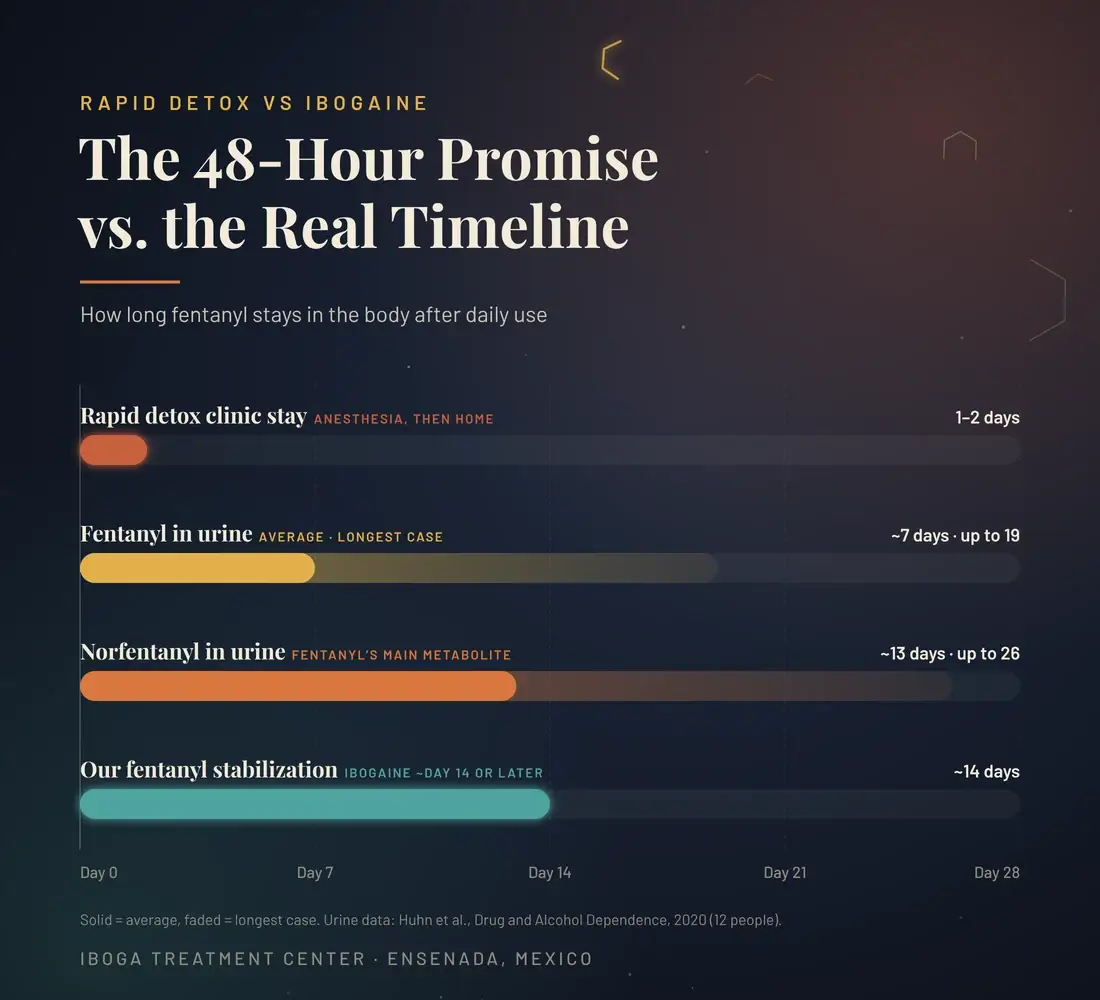
A 2020 study of people entering a residential program tracked how long fentanyl stayed in their urine. Fentanyl itself took about 7 days on average to clear, and as long as 19. Its main breakdown product, norfentanyl, averaged about 13 days, and one person was still testing positive at day 26.
That lines up with what our medical team sees. Getting fentanyl and its metabolites fully out of the body routinely takes us to day 14, and sometimes longer. A one- or two-day procedure is over long before the drug is.
How Ibogaine Treatment Handles Opioid Withdrawal
Instead of forcing withdrawal into a few hours, our process follows the pace your body sets:
- Screening first. An EKG and bloodwork, plus a complete look at everything you’ve been taking, because ibogaine affects heart rhythm.
- Stabilization. Our medical team keeps you comfortable while the substance you came in on clears, which can include moving you to a shorter-acting opioid first. For fentanyl this usually takes about two weeks.
- The ibogaine session. Two or more doctors stay with you, your heart is monitored the whole time, and magnesium is given to help protect it.
- Time to recover. Rest, real meals, sleep and work with counselors before you go home with an aftercare plan.
Ibogaine itself is known for quieting withdrawal. In a 2018 study of 30 opioid-dependent people treated in Mexico, withdrawal scores dropped by more than half within roughly three days of treatment.
Is It Comfortable? An Honest Answer
Our stabilization is built to keep you as comfortable as possible, and our team deals with symptoms as they come up rather than waiting them out. It isn’t painless, and we won’t pretend it is. There are hard moments. But guests regularly tell us it was the easiest detox they’ve ever been through.
That honesty matters. A clinic that promises zero discomfort is selling something. What you get with us is a medical team that pays close attention and responds when something changes, rather than leaving you to ride it out alone.
Rapid Detox vs Ibogaine Treatment at a Glance
Here’s how the two approaches compare on the things that matter most when you’re coming off opioids.
| Rapid detox | Ibogaine treatment with us | |
|---|---|---|
| Anesthesia or sedation | Yes: general anesthesia or deep sedation | None |
| How withdrawal is handled | Forced all at once with naltrexone while you’re unconscious | Managed over days while the drug clears, then eased by ibogaine |
| Typical time on site | Usually 1 to 3 days | 1 to 4 weeks or longer; 4 weeks most recommended |
| Fit for fentanyl | Built on a 24–48 hour window, though fentanyl can take two weeks or more to clear | Stabilization timed to fentanyl, with ibogaine no sooner than about day 14 |
| Safety record | Life-threatening complications in a 2005 trial; deaths reported by the CDC in 2013 | Heart screening first, more than one doctor at every session, cardiac monitoring |
| What happens next | Usually naltrexone and outpatient follow-up | Recovery time on site and an aftercare plan before you leave |
How Long Opioid Treatment Takes With Us
Program length depends on what you’re coming off. People leaving fentanyl, methadone or Suboxone generally stay at least a month, since stabilization alone can take two weeks before ibogaine is safe. Four weeks is our most recommended program. Every program length and price is listed on our ibogaine treatment cost page, and each substance has its own guide:
Questions to Ask Any Detox Provider
Whether you’re looking at a rapid detox clinic, an ibogaine program or something else entirely, these questions separate careful providers from the rest:
- Is a doctor physically present for the riskiest part, and who handles an emergency?
- How will you check my heart before treatment?
- How long will I stay, and how will you know my body is ready to leave?
- How do you plan around fentanyl, given how long it stays in the body?
- What support do I have after I go home?
If you’re a parent or partner researching for someone you love, these are fair questions to ask on their behalf. Our guide to how we prepare you shows how we answer them, and our honest look at ibogaine safety covers the risks. When you’re ready to compare, start with our medically supervised ibogaine center.
Rapid Detox vs Ibogaine: Frequently Asked Questions
Clear answers for anyone weighing a fast detox against ibogaine.
What is rapid detox?
Rapid detox, or anesthesia-assisted rapid opioid detox, uses general anesthesia or deep sedation while naltrexone pushes opioids off the brain’s receptors. The procedure itself usually lasts four to six hours, and most clinics discharge people within a day or two.
Is rapid detox safe?
It carries real risks. A 2005 randomized trial found three potentially life-threatening complications in the anesthesia group and no easier withdrawal than other methods. The CDC later reported two deaths among rapid detox patients at a single New York City clinic in 2012.
How much does rapid detox cost?
Rapid detox cost varies widely from clinic to clinic. When comparing quotes, ask what’s included once you wake up, since the procedure lasts only a day or two. Our own program lengths and prices are on our cost page.
Does rapid detox work for fentanyl?
Fentanyl can stay in the body far longer than a one- or two-day procedure lasts. In a 2020 study, norfentanyl took about 13 days on average to clear the urine, and up to 26 days. That’s why we plan around roughly two weeks of stabilization for fentanyl.
Is ibogaine a type of rapid detox?
No. We don’t use anesthesia, sedation to sleep through withdrawal, or naltrexone to force it. Guests are stabilized first, ibogaine is given once the body is ready, and there’s time to recover before going home.
Will detox with ibogaine hurt?
Some days are hard, and we’re upfront about that. Our medical team treats symptoms as soon as they appear and keeps stabilization as gentle as it can be, and many guests describe it as the easiest detox of their lives.
How long does ibogaine treatment for opioids take?
For fentanyl, methadone or Suboxone, plan on a month or longer. With fentanyl, the ibogaine session typically comes no sooner than about day 14. Our ibogaine treatment programs page lays out each length.
Why does ibogaine treatment take longer than rapid detox?
Because the goal is different. Rapid detox aims to clear opioids from your receptors in a day. We aim to get the drug fully out of your system safely, use ibogaine to interrupt withdrawal and cravings, and give you time to recover before you leave.
Want Off Opioids Without Cutting Corners?
Tell our admissions team what you’re taking, and we’ll talk through how long a safe stay would be for you. There’s no obligation.
Questions first? Call our admissions line at (877) 876-4157. Your call stays confidential.