Does Kratom Show Up on a Drug Test?
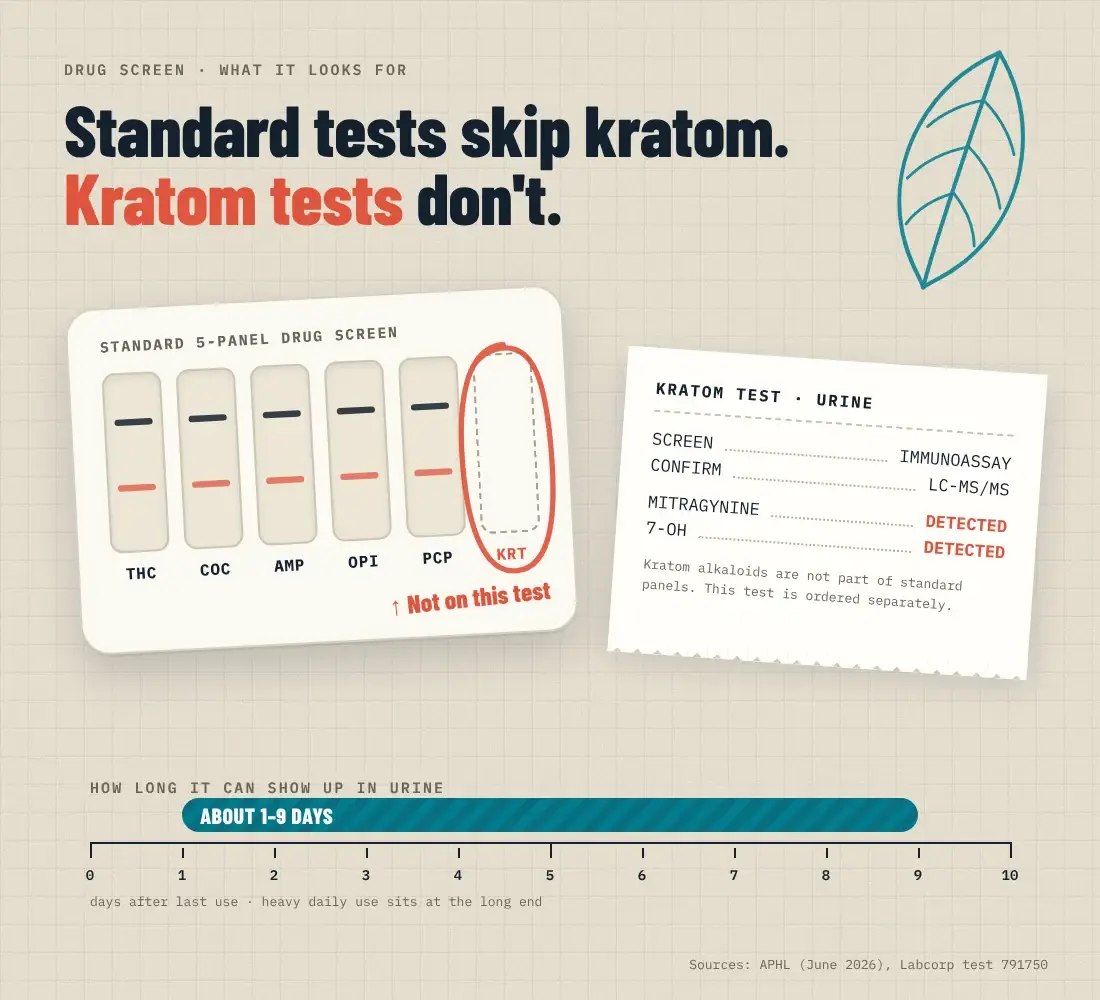
Standard drug tests don’t look for kratom. A kratom-specific test does, and it can pick up kratom and 7-OH for days after you last used.
Medically reviewed by Dr. Gibran Guardado, Medical Director
Usually Not, Unless Someone Tests for It on Purpose
Kratom does not show up on a standard 5-panel or 10-panel drug test. Those tests look for a fixed list of drugs, and kratom isn’t on it. Its main compound, mitragynine, also doesn’t trigger the usual opiate screen, even though it acts on the same receptors in the brain.
That changes when someone orders a test made for kratom. Major labs offer one, and it detects both mitragynine and 7-OH. Employers with expanded panels, probation and court programs, pain clinics and treatment programs can all request it. In urine, kratom can usually be found for several days after your last dose, and sometimes for a week or more after heavy daily use.
This guide comes from Iboga Treatment Center, where our team in Ensenada, Mexico helps people get off kratom and 7-OH with full medical support. If you’re asking about a drug test because kratom has become a daily habit, the last section is for you.
What Standard Drug Tests Look For
Most drug tests are “panels,” a set list of substances the lab screens for. The number tells you roughly how many drug classes are on the list. None of the common panels include kratom.
| Test | What it usually checks for | Kratom included? |
|---|---|---|
| 5-panel (including the federal DOT test) | Marijuana, cocaine, amphetamines, opioids and PCP | No |
| 10-panel | The 5-panel plus drugs like benzodiazepines, barbiturates and methadone (lists vary by lab) | No |
| 12-panel and up | Wider lists that can add drugs like oxycodone, buprenorphine or MDMA | Not unless added |
| Kratom-specific test | Mitragynine and 7-hydroxymitragynine (7-OH) | Yes |
The federal Department of Transportation test is set by regulation (49 CFR 40.82), and kratom isn’t on it. Private employers can build their own panels, though, so the only way to know what a specific test covers is to ask or read the policy.
How a Kratom Drug Test Works and Who Orders It
A kratom test has to be ordered separately. Labcorp’s kratom urine test, for example, starts with a quick screen and confirms any positive result with liquid chromatography and mass spectrometry (LC-MS/MS). That second step identifies the exact compound, so the report can name mitragynine or 7-OH specifically.
Kratom testing is more likely in a few situations:
- Probation, parole and drug courts, which often use wider panels than workplaces
- Pain management clinics, which check that the people they prescribe to aren’t taking anything that interacts with their medications
- Addiction treatment programs, including programs that use medications for opioid use disorder
- Some employers, especially in safety-sensitive jobs, healthcare and the military
- Custody cases and athletics, where a court or league sets the panel
We can’t tell you what any one program tests for. If the stakes are high, such as a job, a court date or custody, ask directly or check the written policy.
How Long Does Kratom Stay in Your System?
Kratom leaves the body fairly slowly. In a 2015 study of long-term kratom users (Trakulsrichai and colleagues, 10 men who drank kratom tea daily), mitragynine had an average half-life of about 23 hours, with wide variation from person to person. Drugs are mostly cleared after about five half-lives, so for an average person that’s roughly four to five days, and longer for some.
Detection times depend on the kind of sample. These are rough ranges, not guarantees:
| Sample | Roughly how far back it can detect kratom | How often it’s used |
|---|---|---|
| Urine | Several days, often up to a week; about 1 to 9 days for 7-OH | The most common kratom test |
| Blood | About 1 to 2 days | Mostly hospitals and investigations |
| Saliva | About a day | Rare for kratom |
| Hair | Up to about 90 days | Rare; mostly legal cases |
The Association of Public Health Laboratories noted in June 2026 that 7-OH can be found in urine for about 1 to 9 days, depending on how much someone used. There’s no single cutoff that applies to everyone.
Why Kratom Stays Detectable Longer for Some People
Two people can stop kratom on the same day and get different results a week later. The main reasons:
- How often you use it. Daily use builds up kratom alkaloids in the body, so they take longer to clear than after a single dose.
- How strong the product is. Extracts, shots and 7-OH tablets carry far more alkaloids than plain leaf powder.
- Your metabolism. Mitragynine is broken down in the liver. Age, liver health and other medications can speed that up or slow it down.
- The test itself. Each lab sets its own cutoff. A more sensitive test can pick up smaller amounts for longer.
If you’ve been using concentrated products every day for months, plan on the longer end of every range in this guide.
Does 7-OH Show Up on a Drug Test?
7-OH (7-hydroxymitragynine) is the stronger kratom compound now sold on its own in tablets, shots and vapes. Like kratom leaf, it isn’t on standard 5-panel or 10-panel tests. Kratom-specific tests do look for it, and Labcorp’s test reports it as a separate result.
Public health labs are also starting to test for mitragynine pseudoindoxyl, a related compound sold as “pseudo.” We explain those newer products in our guide to pseudo and MGM-15.
The legal picture is moving too. The DEA has moved to place 7-OH in Schedule I on a temporary basis, which would make it illegal under federal law. Our post on whether 7-OH is banned has the latest. If you want to understand what 7-OH is and how it differs from leaf, start with what 7-OH is and 7-OH vs kratom.
Can Kratom Make You Fail a Test for Something Else?
Kratom on its own doesn’t usually trigger a positive result for opiates, methadone or other drugs on a standard panel. Its chemical structure is different enough that the common screens don’t react to it.
The bigger risk is what’s actually in the product. Kratom and 7-OH products aren’t regulated like medicines, and labels don’t always match the contents. A product mixed with another substance could cause a real positive for that substance.
If you take prescription medications, tell the person collecting the test. A positive screen should be confirmed by a second, more precise test before anyone acts on it, and you can ask whether that confirmation was done.
Can You Flush Kratom Out of Your System Faster?
No. Only time clears kratom from your body. Detox drinks and cleanses haven’t been shown to speed it up, and drinking large amounts of water mostly makes a sample look diluted. Labs check for that, and many programs treat a diluted sample as a failed or invalid test.
What actually helps is stopping, and for daily users that’s the hard part. Kratom withdrawal can bring aches, sweating, restless legs, diarrhea, anxiety and insomnia, and many people go back to kratom to make it stop. Our 7-OH withdrawal timeline explains what those first weeks look like, and why sleep can stay rough for a while.
When a Drug Test Is the Reason You Want to Quit
For a lot of people, an upcoming test is the moment they realize how much kratom is running their day. If that’s where you are, you don’t have to white-knuckle it alone.
At our ibogaine clinic in Baja California, kratom and 7-OH detox happens on site before anyone takes ibogaine. After heavy kratom use, it often takes a couple of weeks to clear the alkaloids from the body and get a guest ready for treatment. That’s why our kratom stays run at least two weeks, and many guests need closer to a month. Doctors are present for the ibogaine session itself, and a medical team is on site at every hour of the day.
Read more about kratom detox and treatment or 7-OH addiction treatment, see how our programs are structured, or check what treatment costs.
Kratom Drug Testing: Frequently Asked Questions
Short answers to the drug-test questions people ask us most.
Does kratom show up on a 5-panel drug test?
No. A 5-panel test checks for marijuana, cocaine, amphetamines, opioids and PCP. Kratom isn’t on that list, and its main compound doesn’t usually trigger the opiate screen. It only shows up if a kratom-specific test is ordered.
Does kratom show up on a 10-panel or 12-panel drug test?
Not usually. Those panels add more drug classes, such as benzodiazepines and methadone, but kratom isn’t a standard part of them. Some labs offer expanded panels that include kratom, so ask what your test covers.
How long does kratom stay in your urine?
Usually several days, and often up to a week. Heavy daily use, especially of extracts or 7-OH products, can push that toward 9 days or more. The exact time depends on how much you used, your metabolism and the test’s cutoff.
Can my employer test me for kratom?
In many places, yes, if their policy allows it. Private employers can add a kratom test to their panel. Federal DOT tests don’t include kratom. Check your employer’s written drug-testing policy to see what they screen for.
Does 7-OH show up on a drug test?
Not on standard panels. Kratom-specific tests detect 7-OH and report it separately from mitragynine. Public health labs report that 7-OH can be found in urine for about 1 to 9 days, depending on use.
Will kratom make me test positive for opiates?
Kratom by itself doesn’t usually cause a positive opiate result. A product that contains other drugs could, because labels aren’t always accurate. A positive screen should be confirmed with a second, more precise test.
Does kratom show up on a DOT drug test?
No. The federal DOT panel is fixed by regulation and doesn’t include kratom or 7-OH. That doesn’t make them safe for safety-sensitive work, and employers can still have their own rules about them.
How long does it take to detox from kratom?
It depends on how much and how long you’ve used. After heavy kratom or 7-OH use, our team often needs a couple of weeks of on-site detox to clear the alkaloids before ibogaine treatment, which is why our kratom stays start at two weeks.
Tired of Planning Your Life Around Kratom?
If kratom or 7-OH has become something you need every day, our admissions team can walk you through detox and ibogaine treatment, privately and without judgment.
Would you rather talk first? Call admissions on (877) 876-4157. Someone answers 24 hours a day, and the call is confidential.