Pseudo (Mitragynine Pseudoindoxyl) and MGM-15: The New 7-OH Products Explained
As 7-OH bans spread, stronger lab-modified kratom compounds took its place. Here is what pseudo, MGM-15 and MGM-16 are, where the law stands and how to get off them.
Medically reviewed by Dr. Gibran Guardado, Medical Director
What Are Pseudo and MGM-15?
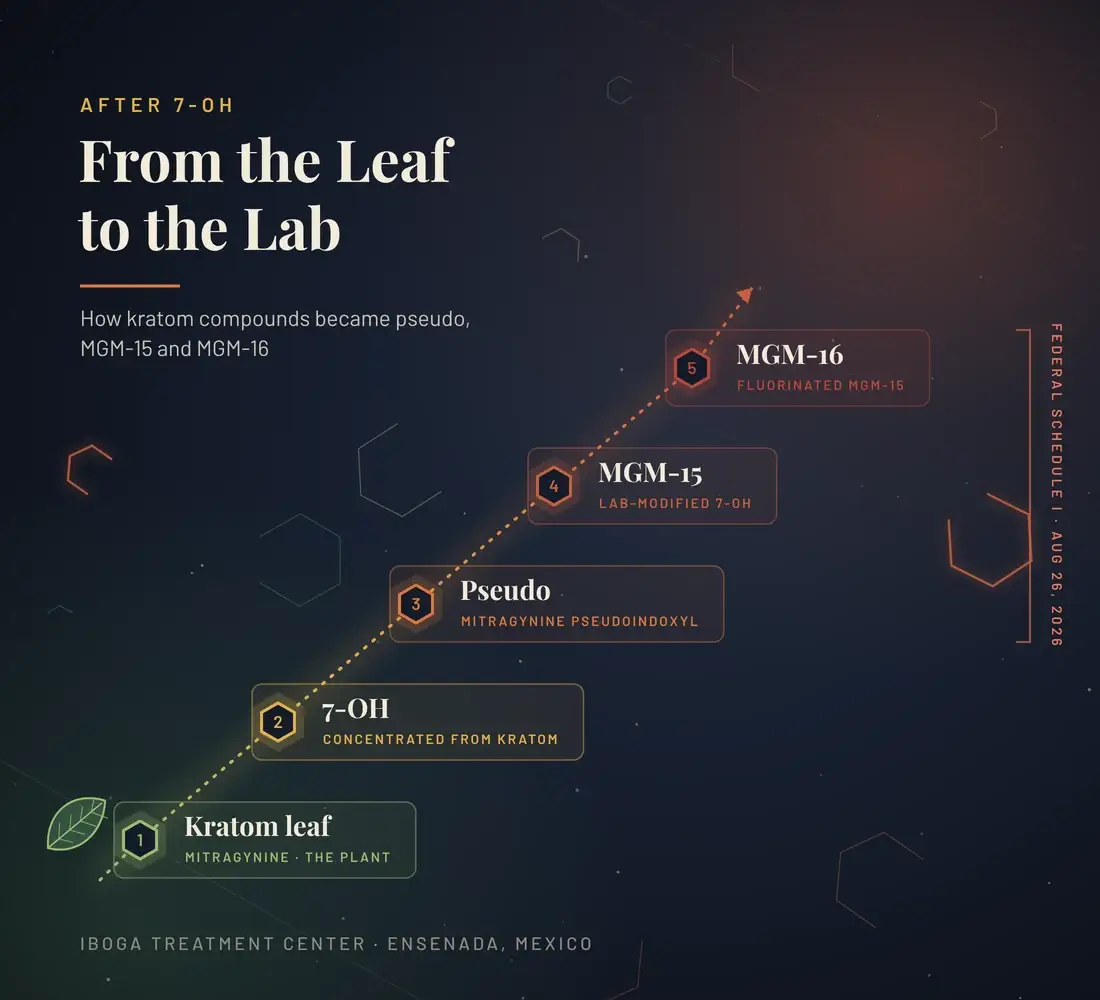
Pseudo is the street name for mitragynine pseudoindoxyl, sometimes shortened to MGPI. MGM-15 is dihydro-7-hydroxymitragynine, and MGM-16 is a fluorinated version of it. All three are made by chemically changing compounds from the kratom plant, and all three act on the same opioid receptors as 7-OH.
They are not kratom leaf, and they are not “natural.” They showed up in smoke shops, gas stations and online stores as states and federal agencies moved against 7-OH, often in the same bright, fruit-flavored tablets and shots. On August 26, 2026, the DEA placed all three in Schedule I.
If you or someone you love has moved from 7-OH to one of these products, you are not alone, and it is not a sign of weakness. These compounds are built to be strong, and getting off them is possible. At Iboga Treatment Center, we help people who started with kratom and ended up somewhere they never expected.
Why Pseudo and MGM-15 Appeared After 7-OH
For a few years, concentrated 7-OH (7-hydroxymitragynine) was sold openly in tablets, gummies and shots. Then the pressure started. The FDA recommended scheduling 7-OH in July 2025, Florida banned it by emergency rule in August 2025, and other states followed.
Sellers responded the way they often do with new drugs: they changed the molecule. Mitragynine pseudoindoxyl was first confirmed in consumer products in 2024, and MGM-15 appeared in commercial products in September 2025. Both were marketed to the same buyers, with similar packaging, and often with little clear labeling about what was inside.
It is the same pattern seen with synthetic cannabinoids and designer opioids. Each ban creates room for a slightly different compound that is not yet listed, and the new versions tend to be stronger, not weaker.
What Is Mitragynine Pseudoindoxyl (Pseudo)?
Mitragynine pseudoindoxyl is a rearranged form of 7-OH. It can be produced by chemically modifying mitragynine or 7-OH, and it can also show up in trace amounts in some kratom-derived products. In March 2025, a lab analysis of smoke shop 7-OH products found detectable pseudoindoxyl in every product tested, so some people may have been taking it without knowing.
According to the DEA, preclinical data show it is a potent mu-opioid agonist, roughly 100 times more potent than mitragynine at that receptor. It is sold as chewable tablets, liquid shots and powders, often in fruit flavors and bright packaging.
Why the early research looked reassuring, and why that changed
A 2016 mouse study in the Journal of Medicinal Chemistry found that pseudoindoxyl relieved pain at lower doses than morphine and, in those animals, caused less tolerance, less withdrawal and less breathing suppression. That made it interesting to researchers.
Real-world use tells a different story. The DEA’s toxicology program identified mitragynine pseudoindoxyl in at least 31 overdose cases between February 2025 and February 2026, and 25 of them were fatal. People taking unregulated tablets of unknown strength, often mixed with other substances, are not lab mice on measured doses.
What Is MGM-15? And What About MGM-16?
MGM-15 (dihydro-7-hydroxymitragynine) was first reported by researchers in 2014 as part of drug discovery work on kratom compounds. It is a semi-synthetic derivative of 7-OH, and in research it binds the mu-opioid receptor more strongly than 7-OH does. The DEA describes it as about 50 times more potent than morphine in animal models.
MGM-16 is a fluorinated version of MGM-15 made for research. In animal studies it was about 240 times more potent than morphine at relieving pain. The DEA has said there is no clear evidence it has reached store shelves, but it has been listed for sale online, which is why it was scheduled at the same time.
Neither compound has ever been approved for medical use, and neither has been studied in people. Anyone taking them is, in effect, the first test subject.
Kratom, 7-OH, Pseudo and MGM-15 Compared
Here is how these compounds relate to each other, and where each one stood under federal law as of November 2026.
| Compound | Where it comes from | How it is sold | Federal status (Nov 2026) |
|---|---|---|---|
| Kratom leaf (mitragynine) | The leaves of the kratom tree | Powder, capsules, teas | Not federally controlled |
| 7-OH (7-hydroxymitragynine) | Occurs in trace amounts in kratom; concentrated in products | Tablets, gummies, shots, vapes | DEA notice of intent issued Oct 2026; temporary order expected on or after Nov 13, 2026 |
| Pseudo (mitragynine pseudoindoxyl) | Chemically modified mitragynine or 7-OH | Chewable tablets, liquid shots, powders | Temporary Schedule I since Aug 26, 2026 |
| MGM-15 | Semi-synthetic derivative of 7-OH | Tablets and liquids, from Sept 2025 | Temporary Schedule I since Aug 26, 2026 |
| MGM-16 | Fluorinated research version of MGM-15 | Listed online; little evidence in stores | Temporary Schedule I since Aug 26, 2026 |
For a closer look at how the plant itself differs from concentrated products, see 7-OH vs kratom.
Are Pseudo and MGM-15 Legal?
No, not federally. The DEA’s temporary scheduling order placed mitragynine pseudoindoxyl, MGM-15 and MGM-16 in Schedule I effective August 26, 2026. It lasts until August 26, 2028, unless the DEA extends it or makes it permanent. Schedule I means no accepted medical use, and selling or possessing these compounds is a federal crime.
In October 2026, the Department of Justice announced a revised approach for 7-OH and pseudo based on concentration. Products with more than 1 mg per gram (or per milliliter) of either compound, or with less than 100 parts mitragynine for each part 7-OH or pseudo, would fall under the controls. The goal is to target concentrated products while leaving ordinary botanical kratom alone.
States have moved too. Florida’s June 2026 emergency rule covers seven compounds, including pseudoindoxyl, MGM-15 and MGM-16; our page on ibogaine treatment for Florida residents explains what that means if you live there. For the full picture on 7-OH itself, read is 7-OH banned?
Can You Get Addicted to Pseudo or MGM-15?
Yes. These compounds activate the mu-opioid receptor, the same receptor targeted by oxycodone, heroin and fentanyl. Regular use leads to tolerance and physical dependence, and stopping suddenly brings opioid-type withdrawal. The DEA’s scheduling documents cite dependence, withdrawal, breathing suppression and heart risks.
Because these products are strong and their strength varies from batch to batch, tolerance can build quickly. Withdrawal can feel like a stronger version of 7-OH withdrawal: aching, sweating, diarrhea, restlessness, anxiety and many nights without real sleep.
Safety basics while you are still using
- Don’t mix these products with alcohol, benzodiazepines or other opioids. Combining depressants is how many overdoses happen.
- Never use by yourself, and have naloxone (Narcan) nearby. It works on opioid overdoses, including these compounds.
- Don’t quit cold turkey alone if you have been using heavily. Withdrawal is not usually life-threatening by itself, but the relapse that often follows can be, because tolerance drops fast.
Getting Off Pseudo or MGM-15 With Ibogaine
Ibogaine’s reputation rests on how it eases opioid withdrawal and cravings, which is why people coming off kratom-derived opioids look into it. Our 7-OH addiction treatment program is the closest match: our doctors stabilize you first, then schedule the ibogaine session once your body can handle it, with doctors present throughout. 7-OH stays run a minimum of two weeks and can stretch to a month.
With pseudo and MGM-15, honesty matters even more. Tell our admissions team exactly what you have taken, including product names and how much, so our doctors can review it before deciding whether and when ibogaine is right for you. If you also use kratom leaf, our page on kratom addiction treatment covers that side.
We provide ibogaine detox in Mexico; three medical doctors work on our team, and medical monitoring continues through every flood dose. Stay lengths are laid out on our ibogaine programs page, and the ibogaine treatment cost page lists current pricing.
Signs Someone Has Switched From 7-OH to Pseudo or MGM-15
Families are often the first to notice a change. Things to watch for:
- New packaging or names: “pseudo,” “MGPI,” “MGM,” “MGM-15” or unfamiliar brand names on tablets and shots.
- Stronger effects: heavier nodding off, slower breathing or pinpoint pupils compared with their usual 7-OH use.
- Online orders: as shelves clear because of bans, buying often moves online.
- Worse withdrawal: sickness within hours of a missed dose, or not being able to sleep at all when they try to stop.
If you are worried about someone, you can call us first, without them. Our admissions line is answered 24 hours a day, and you can apply for treatment on their behalf to start the conversation.
Pseudo and MGM-15: Common Questions
Plain answers about mitragynine pseudoindoxyl, MGM-15 and MGM-16.
What is pseudo kratom?
“Pseudo” is the street name for mitragynine pseudoindoxyl, a compound made by chemically modifying mitragynine or 7-OH from the kratom plant. Despite the name, it is not kratom leaf. It is a potent opioid that the DEA placed in Schedule I on August 26, 2026.
Is mitragynine pseudoindoxyl stronger than 7-OH?
It is generally described as stronger. The DEA says preclinical data show it is about 100 times more potent than mitragynine at the mu-opioid receptor, and mouse research found it relieved pain at lower doses than morphine. Products vary widely, so the real strength of any tablet or shot is unknown.
Is MGM-15 kratom?
No. MGM-15 (dihydro-7-hydroxymitragynine) is a semi-synthetic derivative of 7-OH first described by researchers in 2014. It has never been approved for human use, and the DEA describes it as about 50 times more potent than morphine in animal models.
Is MGM-15 legal?
Not federally. The DEA temporarily placed MGM-15, MGM-16 and mitragynine pseudoindoxyl in Schedule I effective August 26, 2026, through August 26, 2028 unless extended or made permanent. Some states, including Florida, also ban them.
Is pseudo safer than 7-OH?
There is no good reason to think so. Early mouse studies suggested fewer side effects than morphine, but the DEA identified pseudoindoxyl in at least 31 overdose cases between February 2025 and February 2026, 25 of them fatal. Unregulated products of unknown strength carry real overdose risk.
What does withdrawal from pseudo or MGM-15 feel like?
It is opioid-type withdrawal: body aches, sweating, chills, diarrhea, restlessness, anxiety and severe insomnia. Because these compounds are potent, withdrawal can feel stronger than withdrawal from 7-OH, and cravings can last for weeks.
Can ibogaine help with pseudo or MGM-15 dependence?
Ibogaine is used to ease opioid withdrawal and cravings, and these compounds act on the same opioid receptors. Every case is different, so tell our admissions team exactly what you have been taking. Our doctors review it before deciding whether and when ibogaine is right for you.
What should I do if someone overdoses on pseudo or MGM-15?
Call 911 right away. If you have naloxone (Narcan), give it, and stay with the person, turning them on their side if they are breathing. Naloxone works on opioid overdoses, including kratom-derived opioids, but more than one dose may be needed.
Ready to Get Off Pseudo, MGM-15 or 7-OH?
Whatever product you have been using, our admissions team can talk through your options with you, privately and without judgment.
Prefer a call first? Reach admissions at (877) 876-4157, any time of day or night. What you tell us stays confidential.