METHADONE DEPENDENCE TREATMENT
Ibogaine Treatment for Methadone
Many people on methadone have tried to stop and couldn’t. At Iboga Treatment Center, doctors guide you off methadone step by step and give ibogaine only when your body is ready.
UNDERSTANDING METHADONE DEPENDENCE
Methadone Was Supposed to Be the Solution. Now It’s the Problem.
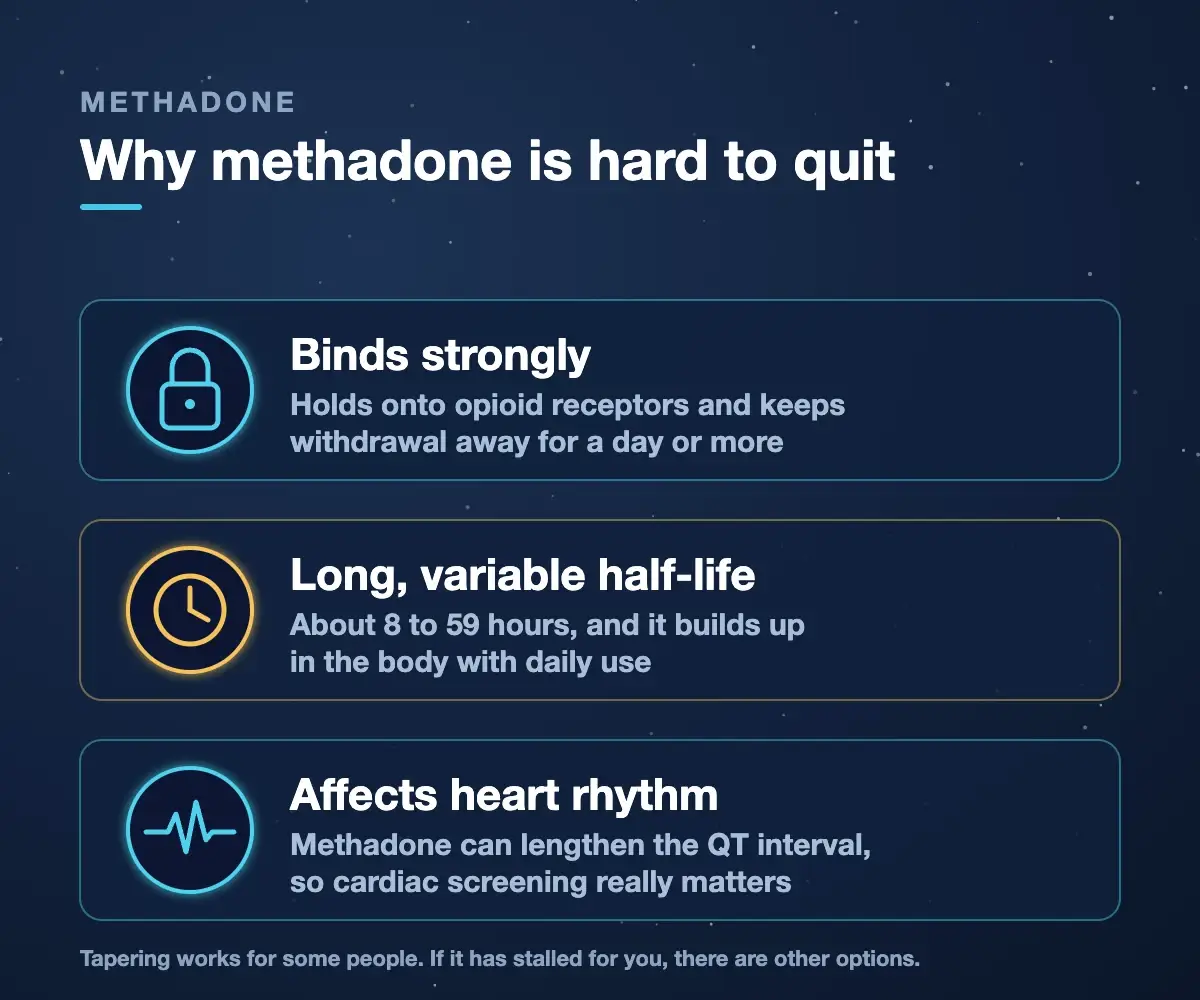
Few medications are prescribed more often for opioid addiction than methadone, and countless people have relied on it. It binds strongly to opioid receptors and suppresses withdrawal and cravings. The very thing that makes it work as maintenance is what makes leaving it so hard.
Methadone stays in the body a long time. Its half-life ranges from about 8 to 59 hours and is often longer than a day, and with daily use it builds up in body tissue. Many people find methadone withdrawal longer and more physically punishing than the drug they originally used. Some people taper successfully, but many get stuck partway, because after months or years the body has adjusted so fully to methadone that life without it can feel out of reach.
Methadone dependence isn’t a character flaw or a lack of willpower. It follows directly from what methadone does to the brain and body, so it needs a medical answer that works on that same level.
WHY IBOGAINE
How Ibogaine Can Help With Methadone Dependence
Ibogaine works on opioid receptors as well as the dopamine and serotonin pathways that shape craving and mood. Guests who spent years unable to leave methadone often tell us withdrawal faded during the session and their cravings were much weaker afterward. Research on using ibogaine for methadone is still young, and outcomes vary.
The catch is timing. Methadone lingers in the body and can affect heart rhythm, so ibogaine can’t be given while it’s still active. That’s why our program starts with a careful, medically supervised transition off methadone onto a shorter-acting opioid, and continues until our medical team confirms your body is ready.
Your body turns ibogaine into noribogaine, which lingers for days after the session and may explain why guests so often report calmer moods and lighter cravings. Our page on how ibogaine works goes deeper.

WHY TIME MATTERS
Methadone Takes More Time. We Built Our Program Around That.
Methadone cases need more preparation, more medical oversight and more time than most opioid dependence. Not every clinic is equipped to provide it. Our methadone program was designed around that need: as an ibogaine treatment center in Mexico that plans for longer stays, we build in careful stabilization and on-site aftercare after detox.
Methadone Withdrawal Timeline, With and Without Ibogaine
Quitting methadone without help is slow and painful, and the withdrawal outlasts that of most other opioids. Below, the typical course on your own sits beside our step-by-step process.
Without Ibogaine
On your own
Days 1–3
Withdrawal begins as methadone levels fall. Anxiety, sweating, muscle cramps, insomnia and restlessness.
Days 3–21
The hardest stretch. Severe body aches, depression, stomach upset and very little sleep. This is when many people give up and go back.
Weeks 3–10
Withdrawal drags on. Methadone’s long half-life means symptoms linger longer than with most opioids: fatigue, mood swings, cravings and trouble feeling pleasure.
Months 3–9+
Post-acute withdrawal (PAWS). Unpredictable cravings, emotional flatness, brain fog and low mood, with a high risk of relapse.
Our Methadone Program, Week by Week
Our approach
Weeks 1–2
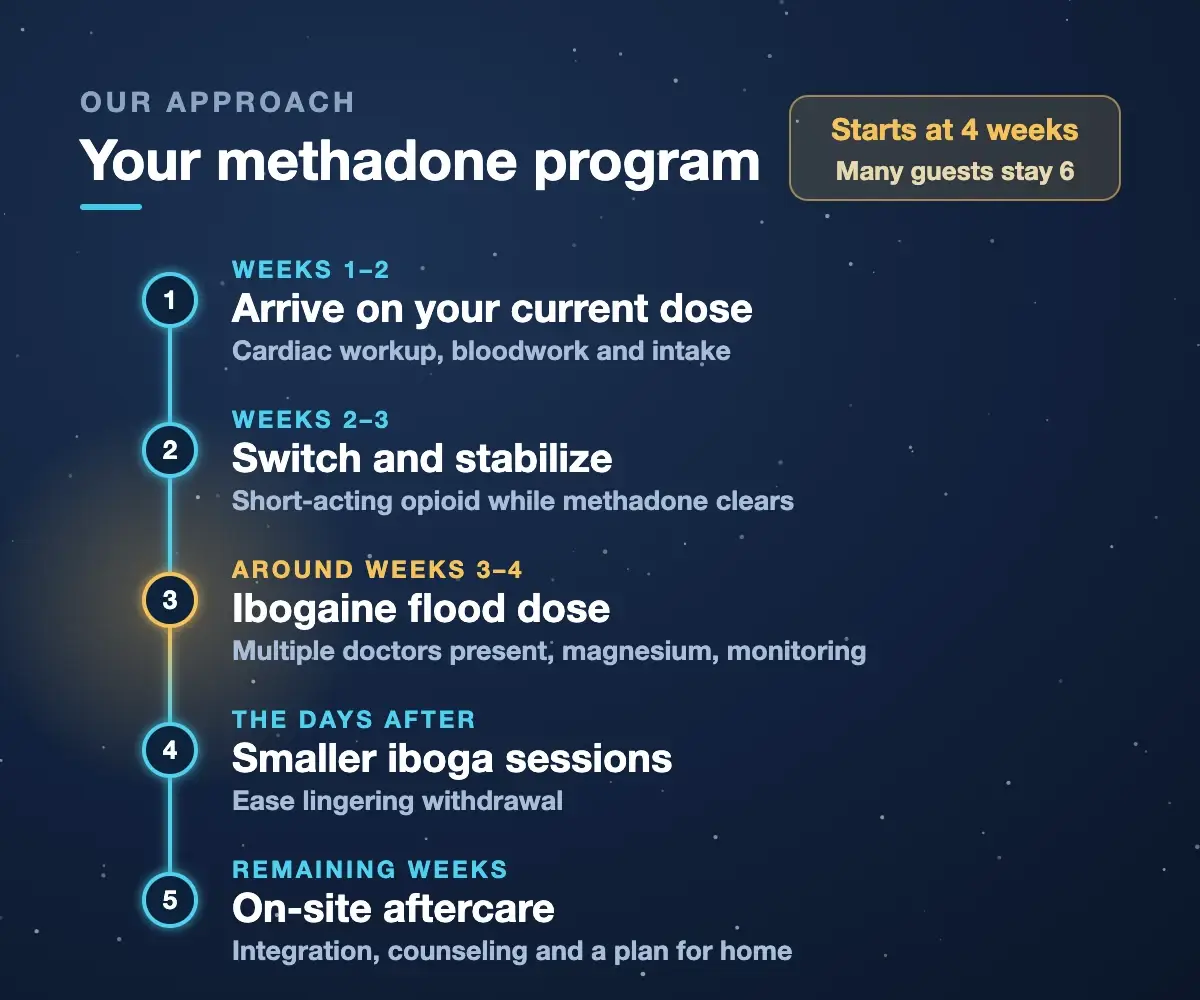
You arrive and go through a full medical intake, bloodwork and an EKG heart check. Your doctor begins moving you from methadone to a shorter-acting opioid.
Weeks 2–3
Stabilization continues while methadone clears, with medical staff on site 24/7. Many guests start feeling better during this phase, before ibogaine is even given.
Around weeks 3–4
When tests show methadone has cleared, you have your flood dose, attended by several doctors, with magnesium and 24 to 36 hours of continuous heart monitoring.
The days after
Smaller iboga doses take care of leftover withdrawal, and noribogaine helps keep mood level and cravings down.
Remaining weeks
Aftercare continues on site: integration work, counseling every day and a residential setting while your nervous system calms down.
When you leave
A plan for life after the clinic, and supervised housing through extended aftercare if you aren’t ready to leave.
Methadone timelines vary widely between people. We set your schedule based on your progress.
HOW TO GET OFF METHADONE
How to Get Off Methadone Safely
Most people try to get off methadone by tapering through their clinic, lowering the dose slowly over months. For some people that works. For others the taper stalls, because each step down brings back cramps, insomnia, depression and cravings.
Our approach is different. Come in on your usual dose; our doctors then switch you to a shorter-acting opioid and keep you stable until the methadone is gone. Ibogaine is then given with several doctors attending and your heart under constant watch, and smaller iboga sessions and on-site aftercare complete the process.
Whatever route you choose, don’t stop methadone suddenly on your own, and don’t switch to Suboxone first without talking to us. Switching adds another long-acting opioid that has to clear. If you’re on Suboxone instead, see ibogaine treatment for Suboxone.
How Long Is a Methadone Program?
4 weeks
Where methadone programs start
6 weeks
A common stay for methadone guests
+ Aftercare
Supervised housing for guests who want more time
Everyone is different. Methadone takes longer to clear, withdrawal lingers longer and the work after detox takes time, so your medical team sets your schedule. Compare our ibogaine treatment programs.
The Iboga Treatment Center Methadone Protocol
Stabilization
Stabilization is the most important part of a methadone program, and we never rush it. As soon as you get here, our doctors start shifting you to a shorter-acting opioid, treating symptoms as they come up, with staff available day and night. Because methadone can affect heart rhythm, your heart is watched closely through every stage.
The Ibogaine Session
After testing confirms methadone is out of your system, the flood dose is given in a well-equipped clinical room, with your heart monitored the whole way through. Several physicians are in attendance, magnesium is administered with the ibogaine, and the medical team stays beside you for 24 to 36 hours. Your care is overseen by the three doctors on our staff.
Post-Flood Iboga Work
Next, gentler iboga sessions calm any remaining withdrawal and bring a quiet, reflective state of mind. Many clinics send you home at this point. We believe this is where the real healing begins.
Integration and Aftercare
Every day, licensed counselors help you unpack what surfaced, recognize your triggers and develop new ways of coping. Your aftercare plan is built with you before you go, and if you need longer, extended aftercare adds supervised housing and therapy.
GUEST STORY
Daniel’s Story
“I was on methadone for nine years. Started at 110mg, got down to 60 over time. I tried to taper off four different times. Three of those times I didn’t make it past day five — the leg cramps and the insomnia and the depression would hit, and I’d give in. The fourth time I got two weeks in and ended up in the ER thinking I was having a heart attack.
The methadone clinic told me some people just stay on it forever. I didn’t want that to be me. I have two kids.
I came to Iboga Treatment Center for the 6-week program. The first three weeks were the stabilization — they transitioned me off methadone onto a short-acting opioid and the medical team kept me steady the whole time. By the time the methadone was finally out of my system, I was already feeling better than I had in years. The flood dose was unlike anything I can describe — the closest I can get is it felt like getting a part of myself back that I’d written off as gone.
The weeks after the flood dose were where the real work happened. The smaller iboga sessions, the counseling, the time. I needed every day of those six weeks. I’ve been off methadone for eight months now. I still can’t believe it.”
Individual results vary. More stories from guests are on our testimonials page.
Methadone and Ibogaine: Your Questions Answered
Is ibogaine safe for people on methadone?
Ibogaine carries real medical risks, and with methadone the two biggest are your heart and timing. Methadone and ibogaine can both affect heart rhythm, and methadone has to clear before your session. No one is approved for treatment without an EKG, bloodwork and a complete medical history, and we keep a close eye on your heart for your entire stay. The session itself is attended by several doctors, includes magnesium with the ibogaine and keeps you under continuous monitoring. If ibogaine isn’t safe for you, we’ll be honest about it.
Can I still be on methadone when I arrive?
Yes. Keep taking your regular dose until you get here; our medical team handles the rest. Once you’re here, your doctor moves you from methadone onto a shorter-acting opioid, with symptom management and medical staff on site 24/7 while methadone clears. Please don’t stop methadone suddenly on your own before you come.
Why can’t ibogaine be given while methadone is still in my system?
Methadone stays active in the body for a long time, and both methadone and ibogaine can affect heart rhythm. Giving ibogaine while methadone is still active adds risk to your heart, and withdrawal may not resolve fully. That’s why our medical team gives the flood dose only after confirming methadone has cleared.
How long does methadone take to clear before ibogaine?
Methadone has one of the longest half-lives of any opioid, roughly 8 to 59 hours depending on the person, and with long-term use it builds up in body tissue. Many methadone guests need around three weeks of medically supervised stabilization before their flood dose. Your doctor decides when you’re ready, and we never rush it.
Should I taper my methadone before coming?
Usually not on your own. Tapering alone often makes things harder: many people who try end up in drawn-out withdrawal before they arrive, which complicates stabilization. We recommend coming on the dose you take now and letting our medical team handle the transition. If you’re already tapering under a doctor’s care, tell admissions during your screening.
Can I switch to Suboxone first to make this easier?
It’s a common idea, but we generally don’t recommend it. Switching from methadone to Suboxone is a hard transition of its own, and once you’re on Suboxone you’ve added another long-acting opioid that has to clear before ibogaine can be given. The most direct path is usually to stay on methadone until you arrive and let our medical team handle it from there. If you’re already on Suboxone, see our ibogaine treatment for Suboxone page.
How long is a methadone program?
Methadone programs start at 4 weeks, and many methadone guests stay 6. Methadone takes longer to clear, withdrawal lingers longer and the work after detox needs time to settle. Everyone is different, so your medical team sets your schedule, and our extended aftercare program offers supervised housing if you need more time.
How long does methadone withdrawal last?
Untreated, methadone withdrawal tends to begin one to three days after the final dose, and the first few weeks are the worst. Since methadone leaves the body slowly, symptoms often last longer than with other opioids, and poor sleep, low mood and cravings may continue for months. With us, stabilization keeps withdrawal under medical control, and many guests feel their symptoms lift during the ibogaine session.
How is methadone detox different from Suboxone detox?
Both need extended stabilization before ibogaine can be given safely. The biggest difference is your heart: methadone has a stronger effect on heart rhythm than Suboxone, so cardiac screening and monitoring are more intensive throughout your stay. The overall program is the same (stabilization, flood dose, post-flood iboga work and integration), but the medical protocol is built around methadone’s longer clearance and cardiac risks.
How much does methadone treatment cost?
Because stabilization takes weeks, methadone programs are longer than most, and your price depends on that length and your medical needs. Admissions will talk through the cost once your screening is done. For an overview, visit the ibogaine treatment cost page.
Can you help me travel to Ensenada?
Our center is in Ensenada, Baja California, about two hours by road from San Diego. When you fly in to San Diego International, a member of our team picks you up, drives you down and gets you through the border crossing. Before you travel, admissions helps you organize the trip and pack the right things. Ibogaine can’t legally be provided in the US, where it’s a Schedule I substance, so our clinic is located in Mexico.
Still have questions? Call admissions at (877) 876-4157.
Ibogaine Treatment for Other Opioids
Buprenorphine has to clear before ibogaine too, so Suboxone programs build in a longer stabilization. See how our Suboxone program works.
Coming off fentanyl takes its own careful preparation before ibogaine. Find out how we treat fentanyl.
For heroin, oxycodone and similar opioids. Ibogaine treatment for opioid dependence, explained.
Everything else we treat is listed on the ibogaine addiction treatment overview.
Ready to Get Off Methadone for Good?
Our admissions team is ready to talk, free and in confidence. Ask anything about leaving methadone; we’ll give you honest answers and no pressure.