Ibogaine Treatment for Texas Residents
Texas is funding ibogaine research, but you still can’t legally receive ibogaine there. Here’s what’s changing in Texas and how Texans reach medically supervised treatment in Ensenada, Mexico.
Is Ibogaine Legal in Texas?
No. Under federal law, which applies in every state, ibogaine sits in Schedule I, the most restricted drug category, and Texas hasn’t carved out an exception. No clinic, doctor or retreat anywhere in Texas can legally treat you with it, whether you live in Houston, Dallas, Austin, San Antonio or El Paso.
What Texas has done is put serious money into research. In 2025 the state committed $50 million to ibogaine clinical trials, with the long-term goal of getting an ibogaine medicine approved by the FDA. That matters, but it’s research, not a treatment program you can sign up for today.
Until that research turns into an approved treatment, Texans who want ibogaine travel abroad, most often to Mexico. Iboga Treatment Center treats guests at our Ensenada clinic under full medical supervision. Below, we walk Texans through the law, the research and the trip.
The Texas Ibogaine Initiative and SB 2308
The state’s ibogaine effort, often called the Texas ibogaine initiative, grew out of a single bill. Here’s how it has unfolded so far:
| When | What happened |
|---|---|
| June 2025 | Governor Greg Abbott signed SB 2308, committing $50 million to a consortium of universities, hospitals and drug developers to run ibogaine clinical trials and pursue FDA approval. Texas would receive a share of revenue from any approved drug, with part of it going to a fund for Texas veterans. |
| December 2025 | The Texas Health and Human Services Commission chose UTHealth Houston, working with UTMB Health, to lead a two-year, multicenter trial looking at ibogaine for addiction, traumatic brain injury and other behavioral health conditions. |
| March 2026 | State leaders said no drug company proposal met the program’s standards and that Texas would move ahead with its own medical researchers instead. |
| April 2026 | A federal executive order directed at least $50 million toward state psychedelic research programs like the one in Texas. |
| October 2026 | No public enrollment date for the Texas trials has been announced. |
Status current as of October 2026, based on reporting from the Texas Tribune, UTHealth Houston and KSAT.
Rick Perry and the Push for Ibogaine in Texas
Former Texas governor Rick Perry has been the best-known champion of the state’s ibogaine effort. He has said he was moved by the experience of Marcus Luttrell, the former Navy SEAL who lived with Perry’s family after his military service while he struggled with PTSD and addiction, and who later found relief through ibogaine.
Perry backed SB 2308 in 2025, and reporting at the time credited him with leading the push after a similar effort in Kentucky stalled. In March 2026, speaking at South by Southwest in Austin, he urged Texas lawmakers to go further and widen legal access to ibogaine for veterans and others living with addiction and PTSD.
Whatever happens next at the Capitol, the practical picture for Texans hasn’t changed yet: there’s still no legal way to receive ibogaine treatment inside the state.
Can Texans Join an Ibogaine Clinical Trial?
Not yet. As of October 2026, the Texas program hasn’t said when it will begin enrolling people or exactly who will qualify. When it does open, expect a limited number of spots and strict medical criteria, with a focus on conditions like opioid addiction and brain injury.
If you’d like to follow it, watch ClinicalTrials.gov and announcements from UTHealth Houston. For anyone who needs help now, treatment outside the US is still the realistic route.
How to Get to Ibogaine Treatment From Texas
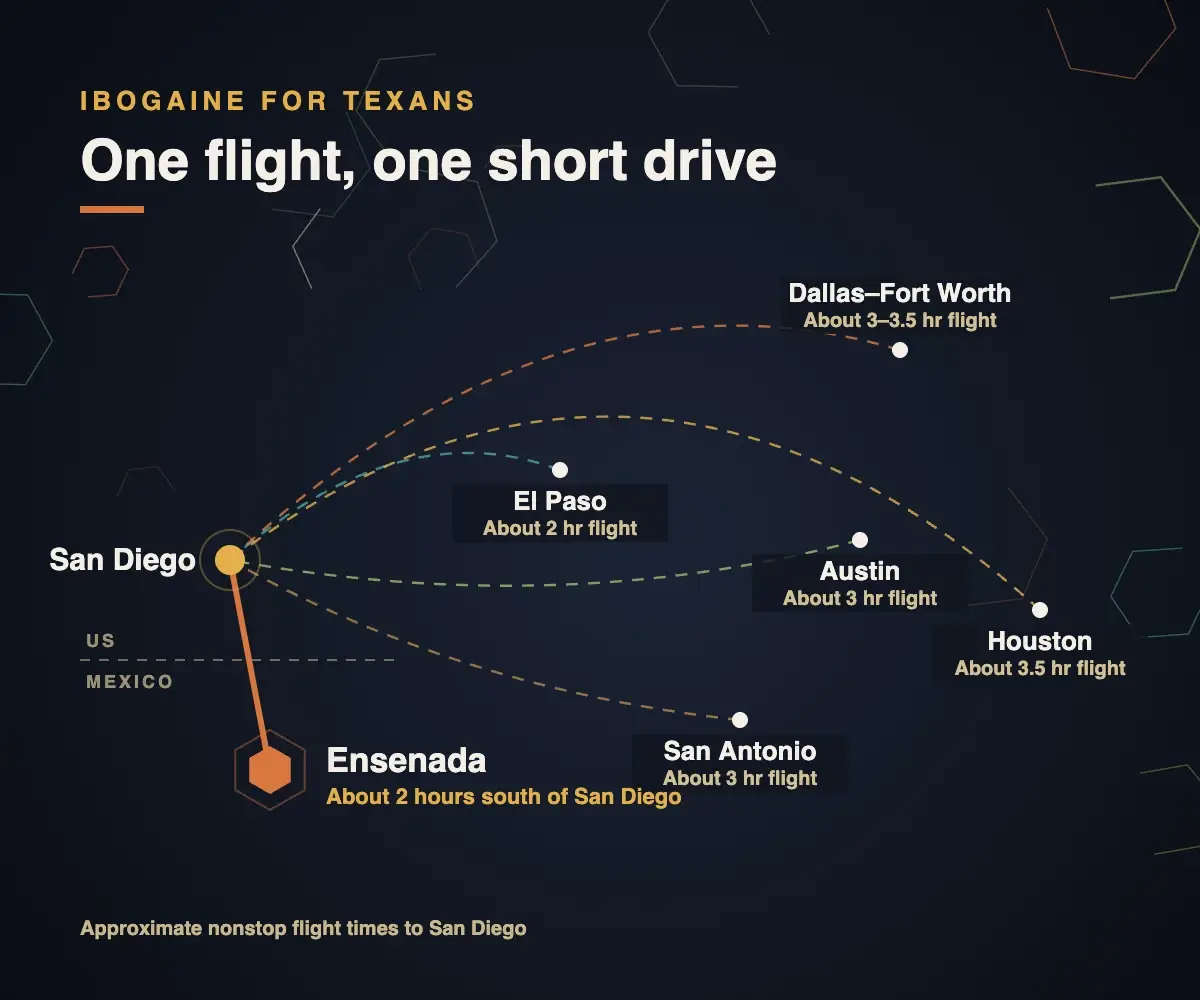
Every major Texas airport has nonstop flights to San Diego, and Ensenada is about a two-hour drive south of there. Approximate flight times:
| Texas city | Airports | Nonstop to San Diego |
|---|---|---|
| Dallas–Fort Worth | DFW and Dallas Love Field | About 3–3½ hours |
| Houston | Bush (IAH) and Hobby | About 3.5 hours |
| Austin | Austin-Bergstrom (AUS) | About 3 hours |
| San Antonio | San Antonio International (SAT) | About 3 hours |
| El Paso | El Paso International (ELP) | About 2 hours |
Times are approximate, and a connection adds a few hours. If you’re helping someone outside Texas, see how the trip works from other US states, or read our page on ibogaine treatment for California residents.
From San Diego to Our Clinic in Ensenada
We’ll arrange your transport from the San Diego airport, or less often from Tijuana’s. Our team meets you, drives you south and crosses the border with you, so you aren’t working out the logistics on your own.
- Bring a passport book or passport card; you’ll need one to re-enter the US by land.
- Leave a day for travel at the start and at the end.
- Pack for a longer stay; admissions will tell you what to bring.
- Never bring ibogaine back into Texas or anywhere else in the US. It’s still a federal Schedule I drug.
What Texans Come to Us For
Fentanyl has driven a steep rise in overdose deaths across Texas, and opioid detox is where our clinic began. Our programs cover:
- fentanyl addiction, including counterfeit pills
- heroin and prescription opioids
- coming off methadone or Suboxone
- alcohol, with medical detox first
- meth, cocaine and Adderall
- kratom and 7-OH
- depression, anxiety and trauma
Each of those pages explains how ibogaine fits in and how long a program for that substance usually runs.
Ibogaine for Texas Veterans
Veterans sit at the center of the Texas ibogaine story. Part of any future revenue from SB 2308 is earmarked for a Texas veterans fund, and the state’s trial includes research on traumatic brain injury, which many service members carry home.
The science is promising but early. Stanford researchers who followed Special Operations veterans after ibogaine with magnesium in Mexico reported large average improvements in PTSD, depression and anxiety, though the study was small and had no placebo group. Our page on ibogaine for PTSD and veterans covers screening, safety and what a program involves.
Why Texans Travel South for Ibogaine
For now, the closest legal options for Texans are ibogaine centers in Mexico, where ibogaine isn’t a controlled substance. Clinics there vary a great deal, so real medical oversight is the thing to look for first.
Our ibogaine treatment in Mexico is built around it. Three medical doctors are part of our team, more than one is beside you for the ibogaine session, magnesium accompanies each dose, and medical staff are present around the clock. Since 2018 we’ve worked with more than 500 guests.
Programs run from one to four weeks, with longer stays and aftercare available. See our ibogaine programs for how a stay is planned, and our ibogaine treatment cost page for pricing.

How Much Time Off Work to Plan For
Most Texans need to plan for the program plus a travel day on each end. How long the program runs depends mainly on what you’re coming off:
- Arriving already clean: as little as one week, decided case by case
- Stimulants like meth or cocaine: usually two to four weeks
- Heroin or prescription opioids: two weeks at minimum, and we recommend four
- Fentanyl, methadone or Suboxone: usually four weeks or more
If you need extended leave, the federal Family and Medical Leave Act may protect your job for up to 12 weeks of unpaid leave for treatment of a serious health condition, depending on your employer and eligibility. Talk to HR before you go; we can’t give employment or legal advice. Aftercare, if you choose it, adds two weeks to three months.
Coming Home to Texas After Ibogaine
The weeks after you get home matter as much as the stay itself. Before you leave, line up support close to where you live: a counselor, a support group or a recovery meeting you can get to easily.
If you need help finding local services, Texas Health and Human Services runs Outreach, Screening, Assessment and Referral (OSAR) centers across the state that connect people with substance use treatment and support. Naloxone (Narcan) is sold over the counter at Texas pharmacies, and anyone in a mental health crisis can reach the 988 line by phone or text.
If opioids were part of your history, your tolerance will be far lower after treatment, which makes an overdose more likely. Our aftercare program can give you more time before that transition if you want it.
How Texans Get Started
- Fill out our online application, or phone us at (877) 876-4157.
- Talk through your health history and the medications you take with admissions.
- Complete a medical screening, including heart testing.
- Choose a program length and dates with our team.
- Book your flight to San Diego, and we’ll take it from there.
Have a question first? Use our contact page and admissions will call you back.
Ibogaine in Texas: Frequently Asked Questions
Common questions from people across Texas.
Is ibogaine legal in Texas?
No. It’s Schedule I under federal law, and Texas hasn’t made an exception. The state is funding research, but no one in Texas can legally treat you with ibogaine today.
What is the Texas ibogaine bill?
SB 2308, signed in June 2025, committed $50 million to ibogaine clinical trials run by a Texas consortium, with the goal of FDA approval. UTHealth Houston and UTMB Health were chosen to lead the research.
When will the Texas ibogaine trials start?
No public enrollment date had been announced as of October 2026. In March 2026, state leaders said Texas would run the research with its own medical researchers after no drug company proposal qualified.
What does Rick Perry have to do with ibogaine?
The former governor led the push for SB 2308 and has spoken publicly about ibogaine helping veterans, inspired in part by former Navy SEAL Marcus Luttrell. In 2026 he urged lawmakers to expand access further.
Can Texans legally get ibogaine treatment in Mexico?
In Mexico, ibogaine isn’t a controlled substance, and many Texans go there for treatment. Don’t bring any ibogaine back across the border. If you’re on probation or have a pending case, talk to a lawyer before you travel.
Which airport should I fly into from Texas?
San Diego International Airport. Nonstop flights leave from DFW, Dallas Love Field, Houston, Austin, San Antonio and El Paso. We arrange transport from San Diego or, less often, Tijuana Airport.
How much time off work will I need?
Plan for your program plus a travel day at each end. Programs run one to four weeks, and opioid programs, especially methadone, Suboxone and fentanyl, are usually four weeks or more.
How much does treatment cost for Texas residents?
Texans pay the same as everyone else. Current prices for each program length are on our cost page.
Texans: Talk to Us About Ibogaine Treatment
Our admissions team can explain the trip from Texas, how screening works and what your stay would involve. There’s no obligation to book.
Prefer a phone call? Admissions is at (877) 876-4157.