Is Ibogaine Legal in the US? What Changed in 2026
Ibogaine is still illegal in the United States. But 2026 brought an executive order, a bill in Congress and new state laws. Here’s what each one means.
Is Ibogaine Legal in the US? The Short Answer
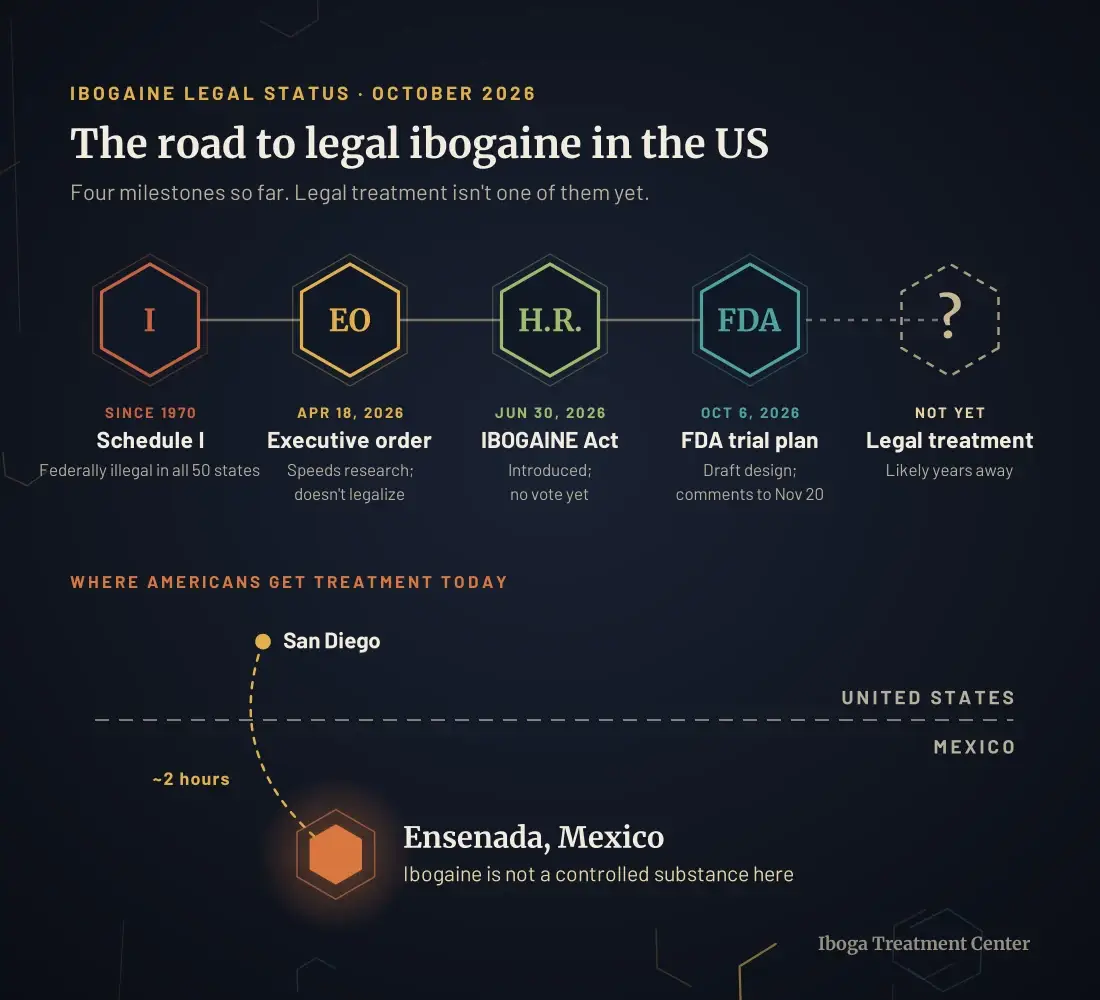
No. As of October 2026, federal law still lists ibogaine in Schedule I of the Controlled Substances Act. That applies in all 50 states. No state has a licensed ibogaine provider, and there is no prescription pathway.
What has changed is the direction. In April 2026 the White House named ibogaine in an executive order. In October the FDA published its first detailed plan for how an ibogaine trial should run. Several states now fund ibogaine research. None of that makes treatment legal yet, and real access in the US is likely years away.
That’s why most Americans who want ibogaine treatment today travel to Mexico, where it isn’t a controlled substance. Below we walk through every piece of the 2026 picture, in plain language, so you know exactly where things stand.
Ibogaine Under Federal Law: Still Schedule I
Ibogaine has been a Schedule I drug under the Controlled Substances Act since 1970. Schedule I is the strictest category. It’s reserved for substances the government says have no accepted medical use and a high potential for abuse.
In practice, that means three things for anyone in the US:
- Possessing, selling or giving ibogaine is a federal crime, whatever state you live in.
- No doctor can prescribe it. It isn’t FDA-approved for any condition.
- Research is possible but hard. Scientists need DEA registration and FDA clearance for each study, which is one reason most ibogaine research has happened abroad.
The iboga plant itself (Tabernanthe iboga) is treated the same way, because it contains ibogaine. If you’re new to the medicine, our guide to what ibogaine is covers where it comes from and how it’s used.
The 2026 Ibogaine Executive Order, Explained
On April 18, 2026, President Trump signed Executive Order 14401, “Accelerating Medical Treatments for Serious Mental Illness.” Ibogaine is the only psychedelic the order names, and it names it twice. Veterans groups pushed hard for it, and former Navy SEAL Marcus Luttrell was in the Oval Office for the signing.
Here’s what the order does:
- Speeds up FDA review. The FDA can award priority review vouchers to psychedelic medicines that hold Breakthrough Therapy status.
- Asks for a Right to Try pathway. The FDA and DEA must build a way for eligible people to access investigational psychedelics, including ibogaine compounds, under the federal Right to Try Act.
- Funds research. At least $50 million in federal money goes to match state investments in psychedelic research, like the program Texas already runs.
- Plans for rescheduling. If a psychedelic drug finishes Phase 3 trials and wins FDA approval, the DEA should move quickly to reschedule it.
And here’s what it doesn’t do: it doesn’t reschedule ibogaine, and it doesn’t make it legal. The order directs agencies to build pathways. It doesn’t open any of them on day one.
Can you use Right to Try for ibogaine yet?
Not yet. The federal Right to Try Act only covers drugs that have completed a Phase 1 clinical trial. Legal analysts at Harvard’s Petrie-Flom Center and elsewhere point out that ibogaine hasn’t cleared that bar in the US. The DEA also still has to publish rules for how doctors could handle a Schedule I drug under Right to Try. Until both happen, the pathway exists on paper only.
What the FDA Did Next (October 2026)
The biggest follow-up so far came on October 6, 2026. The FDA published a request for information on how early-phase ibogaine trials should be designed. It isn’t a rule, and it doesn’t approve anything. But it’s the most detailed picture the agency has ever given of what a US ibogaine trial would look like.
Almost all of it is about the heart. The FDA’s draft plan includes:
- Small groups given a single dose, starting low and capped at 10 mg/kg
- Adults 18 to 55, off psychiatric medications
- Genetic testing for CYP2D6, the liver enzyme that breaks ibogaine down
- Excluding anyone whose baseline heart-rhythm reading (QTcF) is 430 ms or higher
- Continuous heart monitoring for up to 36 hours, and a clean EKG before discharge
The public can comment until November 20, 2026, under docket FDA-2026-N-10429.
The FDA has also let a human study of noribogaine go ahead. Noribogaine is what your body turns ibogaine into, and the trial is testing it for alcohol use disorder. It’s a meaningful step, but noribogaine is a different drug from ibogaine itself.
Why so much focus on the heart? Ibogaine slows the heart’s electrical recovery between beats (a longer QT interval), and that can set off dangerous rhythms. We explain the risk, and how good clinics manage it, in how ibogaine affects the heart and in our post on whether ibogaine is safe.
The IBOGAINE Act in Congress
On June 30, 2026, a bipartisan group of House members introduced H.R. 9559, the IBOGAINE Act. The sponsors are Reps. Morgan Luttrell (R-TX), Lou Correa (D-CA), Jack Bergman (R-MI) and Michael McCaul (R-TX). The bill would write much of the executive order into law, so a future administration couldn’t simply undo it.
Its main provisions:
- The Attorney General would have 60 days to start reviewing whether ibogaine should move from Schedule I to Schedule II.
- Right to Try would be expanded to work around Controlled Substances Act conflicts.
- The DEA would have to act on a doctor’s registration application within 45 days.
- HHS could partner with states and tribes on ibogaine research, and the VA would report to Congress on psychedelic therapy for veterans.
Where it stands: the bill was referred to the Energy and Commerce, Judiciary and Veterans’ Affairs committees. As of late October 2026 it hasn’t had a vote. Even if it passes, Schedule II would mean a tightly controlled prescription drug, not something you could buy or use freely.
Is Ibogaine Legal in Any State?
No state allows ibogaine treatment. State laws can’t override federal Schedule I status, so even the most active states are funding research, not treatment. Still, 2026 was a record year: about 15 states considered ibogaine bills, and several passed them.
| State | What passed | What it means for you |
|---|---|---|
| Texas | SB 2308 (signed June 2025): $50 million for FDA-track ibogaine trials | UTHealth Houston and UTMB lead the work; the state is now running its own study. No enrollment date yet. |
| Colorado | 2022 ballot measure decriminalized personal use; HB26-1325 (signed June 2026) created a research pilot | Lower penalties for personal use under state law, but no licensed providers and still a federal crime |
| Kentucky, Louisiana, Mississippi, Oklahoma, Tennessee | 2026 laws authorizing ibogaine clinical trials | Trials only, once funded and FDA-cleared |
| New Hampshire | Allows ibogaine under an FDA-approved research protocol | Research settings only |
| West Virginia | Trial bill passed, then vetoed (April 2026) | Nothing changed |
For Texans, our page about ibogaine treatment for Texas residents including SB 2308, Rick Perry’s role and the trial timeline. Californians can read about ibogaine treatment for California residents.
How long until a state trial becomes real treatment? A University of Texas researcher told The Daily Texan that FDA approval could take seven to ten years after research begins.
Can You Get Ibogaine Legally in the US Today?
For almost everyone, no. Here’s every route that exists, and how realistic it is in late 2026:
| Route | Status (October 2026) | Realistic for most people? |
|---|---|---|
| FDA-approved prescription | Doesn’t exist | No |
| Right to Try | Ordered by the executive order; not usable yet | Not yet |
| Clinical trial | FDA is still collecting input on trial design; state trials aren’t enrolling | Not yet; spots will be few and criteria strict |
| State decriminalization (Colorado) | Lower state penalties for personal use | No legal supply or providers, and still federally illegal |
| Underground providers | Illegal | No, and often unsafe |
That last row matters. When treatment isn’t legal, some people turn to unlicensed providers in homes or rented spaces. Ibogaine needs heart screening, medical monitoring and staff who can respond to an emergency. Without them, the risks are serious. You can watch ClinicalTrials.gov for US studies as they open.
Is Ibogaine Legal in Mexico?
Yes, in the sense that matters: ibogaine isn’t on Mexico’s list of controlled substances, so clinics can offer it openly. That’s why so many Americans now look into ibogaine therapy in Mexico, at clinics from Baja California to the Caribbean coast. Even US researchers have looked there. The 2024 Stanford study of 30 Special Operations veterans was done at a clinic in Mexico.
There’s an important catch. Ibogaine is unscheduled in Mexico, but it isn’t specifically approved or regulated as a treatment by COFEPRIS, the national health regulator. There are no ibogaine-specific rules on screening, dosing or monitoring. Standards come down to each clinic, and they vary widely.
So “legal in Mexico” doesn’t mean “safe everywhere in Mexico.” It means the choice of clinic is on you. The checklist further down shows what to look for.
Can Americans Legally Travel to Mexico for Ibogaine Treatment?
US drug laws cover what happens in the US, at the border, and in US mail. Traveling to a country where ibogaine isn’t controlled and receiving treatment there is not the same as possessing it at home. Many Americans, including a growing number of veterans, have done exactly that.
Three things to keep in mind:
- Never bring ibogaine back. Carrying ibogaine or iboga across the border, or having it shipped to you, is importing a Schedule I drug. That’s a serious federal crime. Treatment should begin and end at the clinic.
- If you’re on probation, parole or have a pending case, talk to your lawyer first. Your travel and your terms may have conditions we can’t judge.
- Bring a valid passport. You’ll need it, or another accepted document, to re-enter the US by land or air.
We’re not lawyers, and this isn’t legal advice. It’s the general picture, and your situation may be different.
How to Choose a Safe Ibogaine Clinic While It’s Illegal at Home
Since no government sets the standard, use the FDA’s own draft trial plan as your yardstick. A clinic worth trusting will have answers to all of these:
- Medical screening before you’re accepted: a full medication review, blood tests and an EKG
- Doctors, not just facilitators: physicians present during the treatment itself
- Continuous heart monitoring through the long hours after the dose, with emergency equipment on site
- A plan for your current medications, including opioids, antidepressants and benzodiazepines
- Clear answers about who isn’t a candidate, including people with certain heart conditions
- Support after treatment, not just a dose and a ride home
How we do it at Iboga Treatment Center
At Iboga Treatment Center, our clinic sits in Ensenada, two hours or so by car from San Diego. We’ve treated more than 500 guests since 2018. Our medical team includes three physicians. At least two are with you during treatment, and medical staff are in the building day and night. We also give magnesium for heart protection, which the Stanford researchers did too.
A stay lasts between one and four weeks, and our aftercare program adds time on a dedicated property for guests who want it. We arrange your transport from San Diego International Airport, or sometimes from Tijuana’s airport. See our programs, read how we prepare you for ibogaine treatment, or check ibogaine treatment cost to plan ahead.
Ibogaine Legal Status: Frequently Asked Questions
Quick answers to the questions we hear most about ibogaine and the law.
Is ibogaine legal in the US?
No. It’s federally illegal everywhere in the country as a Schedule I drug. There’s no medical exception and no state where you can legally receive treatment.
Did Trump legalize ibogaine?
No. The April 2026 executive order pushes the FDA and DEA to speed up research and build a Right to Try pathway. It didn’t change ibogaine’s schedule or make it legal to use.
When will ibogaine be legal in the US?
Nobody knows for sure. A drug normally has to finish Phase 3 trials and win FDA approval before it’s rescheduled, and US ibogaine trials haven’t started yet. Most experts talk in years, not months.
Is ibogaine legal in Texas?
No. Texas funds ibogaine research through SB 2308, but treatment is still illegal there under federal law. Our Texas page has the full timeline.
Is the iboga plant legal?
Not in the US. Because the root contains ibogaine, the plant falls under the same Schedule I listing.
Is ibogaine legal in Mexico?
It isn’t a controlled substance there, so clinics operate openly. It also isn’t specifically regulated as a treatment, so safety standards depend on the clinic you choose.
Can I bring ibogaine home after treatment?
No. Bringing it across the border or having it mailed to you is a federal crime. All of your treatment should happen at the clinic.
Can I join an ibogaine clinical trial in the US?
Not yet. The FDA is still gathering input on trial design, and state-funded trials haven’t started enrolling. When they do, expect limited spots and strict medical criteria.
Don’t Wait on Washington
US access to ibogaine may be years away. If you’re ready now, talk with our admissions team about medically supervised treatment in Ensenada, Mexico.
Rather talk it through? Call admissions any time at (877) 876-4157. The line is open 24 hours, and every call stays confidential.