7-OH ADDICTION TREATMENT
Ibogaine Treatment for 7-OH Addiction
Medically supervised 7-OH detox in Ensenada, Mexico. We help you through 7-OH withdrawal, and ibogaine gives you a real chance to break the cycle.
THE RISE OF CONCENTRATED 7-OH
Why 7-OH Is So Hard to Quit
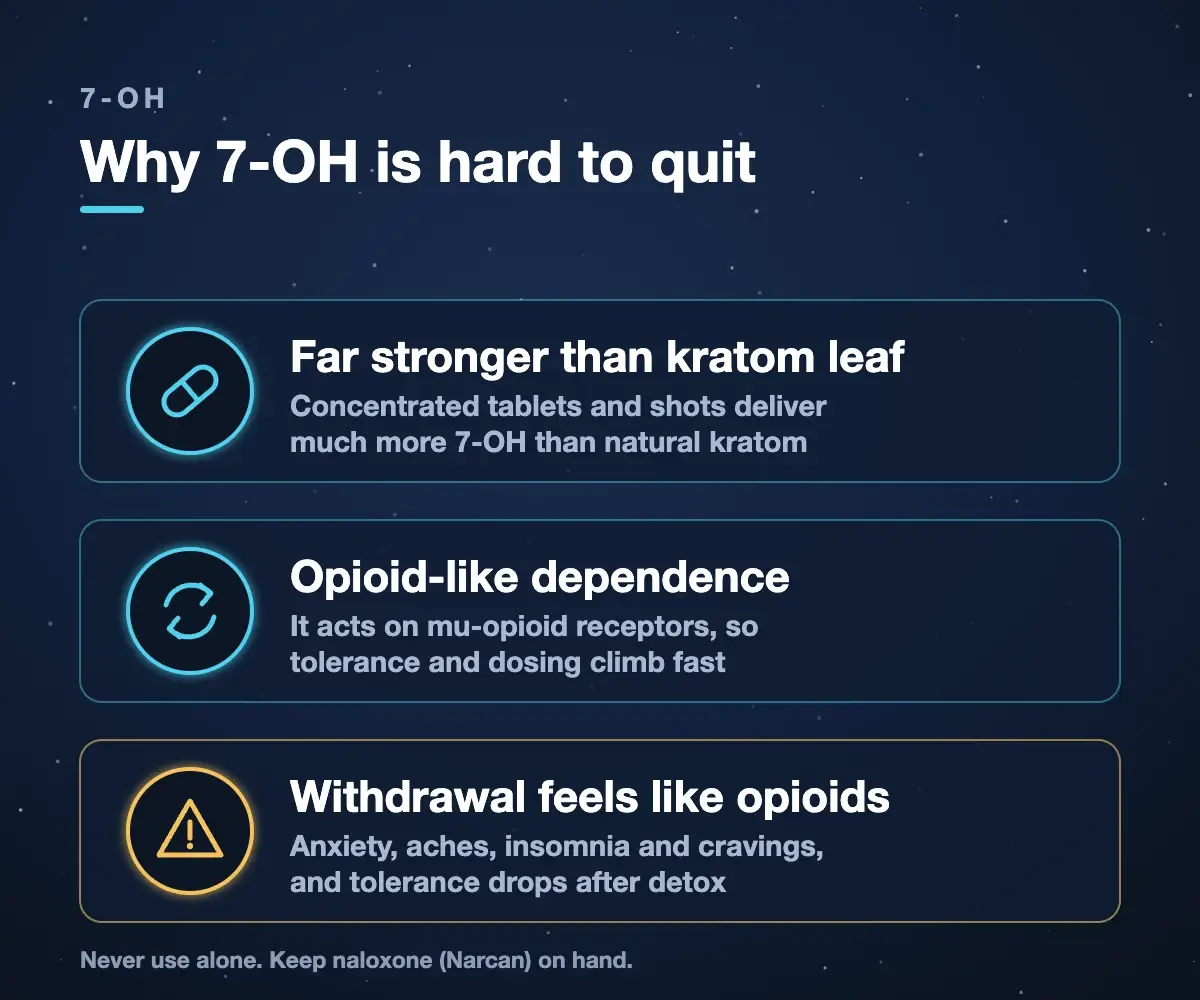
7-hydroxymitragynine, or 7-OH (sometimes written 7OH), is an alkaloid associated with the kratom plant. In natural kratom leaf it’s usually present only in very small amounts, but the concentrated tablets, shots, gummies and other 7-OH products now on sale are made to deliver much higher amounts. Learn more about what 7-OH is.
Because 7-OH acts strongly on the brain’s mu-opioid receptors, frequent use can quickly shift from something you choose to take into something you need just to feel normal. Tolerance rises, doses climb, and stopping brings withdrawal that looks a lot like opioid withdrawal.
A lot of people pick up their first 7-OH at a gas station or smoke shop, thinking it’s a harmless herbal product, and only discover how hooked they are when they try to quit.
7-OH is one of the newer substances our team treats at Iboga Treatment Center in Ensenada, Mexico, and we approach it the same careful way we approach kratom addiction: detox first, then ibogaine, then time to recover.
THE SCIENCE
How Ibogaine Treats 7-OH Addiction
Ibogaine works differently from conventional approaches to opioid dependence. Rather than only managing withdrawal symptoms, it interacts with several brain systems involved in opioid dependence, including opioid receptors and the pathways behind craving, mood and reward. If ibogaine is new to you, start by reading what ibogaine is and how it works.
With frequent 7-OH use, the brain adapts to its strong activity at mu-opioid receptors, leading to tolerance, physical dependence and withdrawal. Ibogaine may help interrupt that cycle, and many guests notice a significant reduction in withdrawal and cravings during or shortly after the session. Its metabolite, noribogaine, stays active for days, which may support steadier mood and fewer cravings while you recover.
We want to be straightforward about the research. There are no studies yet on ibogaine for 7-OH specifically; the evidence comes from studies of opioid dependence. The evidence comes from small open-label opioid studies, such as a study at Mexican clinics and a New Zealand study, which found clear drops in withdrawal and craving; a 2022 systematic review reached the same general conclusion. None of these studies were large, most lacked a control group, and because ibogaine carries real heart risks, it should only be given with careful screening and constant monitoring.

WHY TIME MATTERS
7-OH Detox Takes More Than a Few Days
7-OH withdrawal can drag on, and the weeks after detox are when cravings, poor sleep and the habits built around constant dosing are hardest to resist. As an ibogaine treatment facility in Mexico that’s built for longer stays, we plan on two weeks at minimum, and often a full month, for you to stabilize, heal and prepare for home.
7-OH Withdrawal Timeline, With and Without Ibogaine
7-OH withdrawal can feel a lot like opioid withdrawal, and how hard it hits depends on your daily dose, how often you use and how long you’ve been dependent. Below is a typical 7-OH withdrawal, set against how our team manages each stage.
Without Ibogaine
On your own
First 24 hours
As the effects wear off, withdrawal can start within hours: anxiety, restlessness, sweating, muscle aches, stomach discomfort, insomnia and strong cravings.
Days 2–4
The hardest stretch for many people: significant anxiety, stomach upset, fatigue, muscle pain, poor sleep, irritability and powerful urges to use.
Days 5–10
Physical symptoms gradually ease, but cravings, low energy, disrupted sleep, anxiety and low mood can continue.
Weeks 2 and beyond
Even after the physical symptoms fade, cravings and the habits built around frequent dosing can make staying off 7-OH hard without support.
How We Handle 7-OH Withdrawal
Our approach
First days
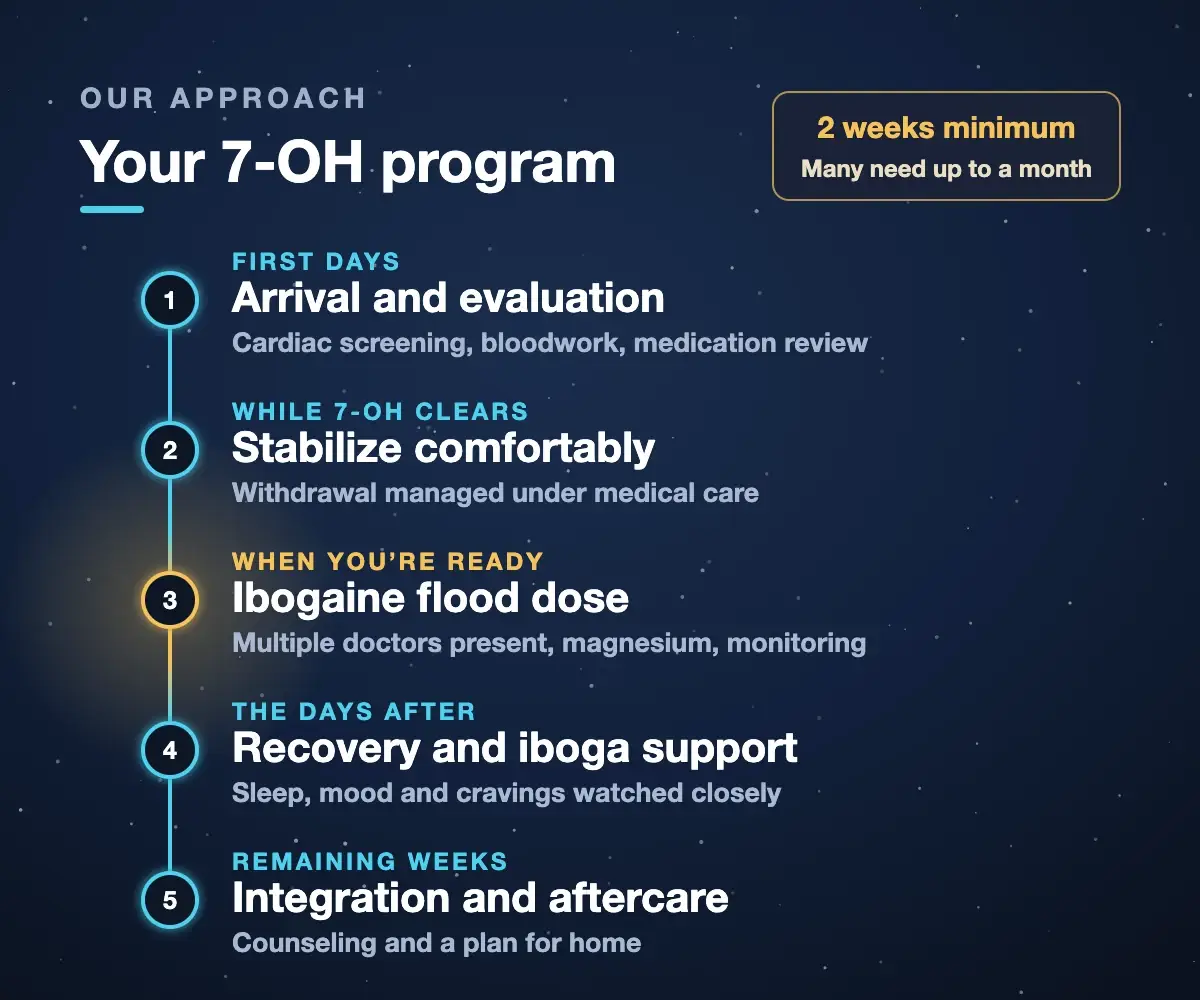
Arrival and evaluation: cardiac screening with an EKG, bloodwork and a review of your medications and other substances.
While 7-OH clears
Medically supervised stabilization, with withdrawal kept under control and medical staff on site 24/7, so you don’t arrive at your session sick or exhausted.
When you’re ready
The flood dose: doctors at your side, magnesium with the ibogaine and your heart monitored without a break.
The days after
A structured recovery period. We watch your sleep, mood, cravings and energy, and smaller iboga sessions may be used when appropriate.
Remaining weeks
Integration therapy, counseling with licensed counselors, nutrition and healthy routines that address the patterns around your 7-OH use.
When you leave
A home plan made just for you, and supervised housing in extended aftercare if you’d like more time.
Everyone’s 7-OH withdrawal is different, and the research on it is still thin. After treatment, your tolerance is much lower, so going back to your old dose, or using any other opioid, especially fentanyl, could be fatal. Never use alone, and keep naloxone (Narcan) on hand.
HOW TO QUIT 7-OH
How to Quit 7-OH Safely
Don’t stop 7-OH abruptly on your own, especially if you dose heavily or throughout the day. Withdrawal can be intense, and going it alone is when many people relapse. Don’t switch to another opioid without medical advice, either.
Our approach: once you’re here, our medical team evaluates your level of dependence and stabilizes you while 7-OH clears your system, keeping withdrawal under control, so you’re ready for your ibogaine session instead of arriving sick, dehydrated or exhausted. After that, ibogaine is given with several doctors attending and nonstop heart monitoring, and recovery time and on-site aftercare follow. We explain the preparation in what happens before ibogaine treatment.
Tell us everything you’ve been taking, including kratom, other opioids or anything that could contain fentanyl. If you’re also on Suboxone or methadone, those need a different plan; see ibogaine for Suboxone and ibogaine for methadone.
How Long Is 7-OH Detox and Treatment?
2 weeks
The minimum, and the fastest possible
Up to a month
What many guests need from start to finish
+ Aftercare
Supervised housing if you’re not ready to go home
The right length depends on how much 7-OH you use, how often you dose, how long you’ve been dependent, and whether kratom, opioids or other substances are involved. Compare our ibogaine treatment programs.
Our 7-OH Detox Program
Evaluation and Stabilization
Rather than taking you straight from heavy 7-OH use into ibogaine, we first evaluate and stabilize you: bloodwork, cardiac screening and a review of your medications and other substances, then medically managed withdrawal while 7-OH clears your system.
The Ibogaine Session
You receive ibogaine in our clinical treatment room, with cardiac monitoring from start to finish. Multiple physicians attend, magnesium is part of the protocol, and our medical staff stay with you through the 24 to 36 hours the session lasts. Three staff doctors are in charge of your care.
Recovery
In the days after, we monitor your sleep, mood, cravings, energy, nutrition and any remaining withdrawal, and smaller iboga sessions may be used when appropriate. Your body gets time to regain strength before you go home.
Integration and Aftercare
Licensed counselors work with you on the experience itself and on breaking the routines built around dosing all day. By the end of your stay, you’ll have an aftercare plan made with you, and supervised housing remains an option if you need longer.
GUEST STORY
Jeff’s Story
“I first found out about 7-OH at a gas station. They told me it was natural, like an herbal medicine. I had never used drugs before, and it felt amazing.
Fast forward two years: I was spending between $100 and $250 a day. I never felt good anymore, and when I didn’t have 7-OH, I felt like I was dying.
I went to detox at a local rehab, and they wanted me to take Suboxone. It made me so incredibly sick that I checked myself out. I was back on 7-OH for another two months.
I found Iboga Treatment Center, and on a hope and a prayer, I decided to go. Man, am I happy I did. I spent one month at the center. The detox went smoothly, and the ibogaine treatment helped get rid of my cravings and withdrawal symptoms.
These guys saved my life. Thank you!”
Individual results vary. For more firsthand accounts, visit our testimonials page.
7-OH Withdrawal and Detox: Your Questions Answered
Is ibogaine safe for 7-OH addiction treatment?
The main medical risk with ibogaine is what it can do to heart rhythm, so screening has to be thorough and monitoring continuous. Rather than taking you straight from heavy 7-OH use into ibogaine, we first evaluate and stabilize you, with bloodwork, cardiac screening and a review of your medications and other substances, and manage withdrawal while 7-OH clears your system. Throughout the session, several doctors are present, magnesium is given with the ibogaine and your vitals are watched without pause. If you have a heart condition or take a medication that rules ibogaine out, we’ll tell you straight away. Want more detail? Read Is Ibogaine Safe? The Honest Answer.
Do I need to stop using 7-OH before coming to the clinic?
No. Please don’t try to stop 7-OH abruptly on your own before you arrive, especially if you’re using heavily or dosing throughout the day. Once you’re here, our medical team evaluates your level of dependence and stabilizes you while 7-OH clears your system, keeping withdrawal under control, so you’re ready for the ibogaine session instead of arriving sick, dehydrated, or exhausted.
Tell us everything you’ve been taking, including kratom, other opioids, or anything that could contain fentanyl. If you’re also on Suboxone or methadone, those need a different plan. We also treat fentanyl addiction.
What are the symptoms of 7-OH withdrawal?
7-OH withdrawal can resemble opioid withdrawal: anxiety, restlessness, insomnia, sweating, muscle aches, stomach cramps, nausea, diarrhea, irritability, fatigue, low mood, and intense cravings. Many people also feel unable to function normally between doses. Its intensity and length come down to your daily amount, your dosing frequency, how many months you’ve been dependent and whether you also use kratom, opioids or anything else.
How long does 7-OH withdrawal last?
It varies with your dose, how often you use and how long you’ve been dependent. Withdrawal often starts within hours of the last dose, is usually hardest over the first several days and eases over a week or two, though cravings, poor sleep and low mood can last longer. Research on 7-OH withdrawal is still limited. In our program, withdrawal is managed medically during stabilization, and many guests notice it ease significantly during or shortly after the ibogaine session.
How quickly can ibogaine help with 7-OH withdrawal symptoms?
Many guests notice a significant reduction in withdrawal symptoms and cravings during or shortly after the ibogaine session. The response varies from person to person, which is why we stabilize and prepare each guest carefully first, then keep supporting sleep, mood, energy, and any remaining symptoms during recovery. Individual results vary.
Is there an overdose risk after ibogaine treatment?
Yes, and it’s one of the most important safety points on this page. After detox and ibogaine, your opioid tolerance drops sharply, so going back to your old 7-OH dose, or using any other opioid, especially fentanyl, can cause a fatal overdose. If you ever return to use, never use alone, and keep naloxone (Narcan) on hand; it’s available without a prescription at US pharmacies. If someone overdoses, give naloxone and call 911.
Your aftercare plan is built to help you avoid that moment. If you’re struggling after you get home, call us, or call or text 988 if you’re in crisis.
How long should I stay for 7-OH addiction treatment?
The shortest possible stay is two weeks, though many guests need up to a month overall. The right length depends on how much 7-OH you use, how often you dose, how long you’ve been dependent, and whether kratom, opioids or other substances are involved. You’ll need a period of medical stabilization before the ibogaine session, then time afterward for recovery, sleep to settle, integration therapy and aftercare planning. After going over your history, admissions will tell you what length of stay to expect. See our program options.
What’s the difference between 7-OH and kratom addiction?
They’re related, but not the same. Traditional kratom contains several natural alkaloids, mainly mitragynine, while concentrated 7-OH products are made to deliver much higher amounts of 7-hydroxymitragynine, which acts strongly on opioid receptors. That’s why 7-OH dependence often looks more like opioid dependence: frequent dosing, fast-rising tolerance, strong cravings, and harder withdrawal. Kratom dependence can also cause withdrawal and compulsive use, and we treat both — see ibogaine treatment for kratom addiction.
Can ibogaine help with 7-OH cravings after detox?
Ibogaine may help reduce cravings by interrupting the opioid-related dependence cycle and giving your brain time to adjust without constant dosing. The weeks after treatment matter most: cravings often ease while sleep, mood, energy, and daily routines start to normalize. We combine ibogaine with recovery time, integration therapy, counseling, and aftercare planning to help you build on that.
How much does 7-OH detox cost?
Two things drive the cost: how long your program runs and the medical care you need, including the stabilization period before ibogaine. Your screening comes first, then admissions explains the cost. See our ibogaine treatment cost page for how pricing is set.
Do you pick guests up from the airport?
Yes. We’re based in Ensenada, Baja California, and the ride from San Diego takes about two hours. Fly in to San Diego’s international airport, and our team will meet you there, drive you south and handle the border for you. Admissions sorts out the travel details with you and tells you what to pack. Our clinic is in Mexico because US law classifies ibogaine as Schedule I, which rules out legal treatment there.
Still have questions? Call admissions at (877) 876-4157.
Kratom, 7-OH and Other Opioids
Long-term kratom use can bring its own dependence and withdrawal. See how our kratom program works.
What concentrated 7-OH is, how it differs from kratom leaf and why it’s so habit-forming.
Heroin, oxycodone and other opioids. See how our opiate detox program works.
For other substances, visit our ibogaine addiction treatment hub.
Ready to Break Free From 7-OH?
Talk with admissions about 7-OH today, free and confidentially. We’ll give you honest answers and leave the decision to you.