COCAINE AND CRACK ADDICTION TREATMENT
Ibogaine Treatment for Cocaine Addiction
Cocaine rewires your brain’s reward system. Our medically supervised cocaine rehab in Ensenada, Mexico gives you safe support through the comedown, ibogaine once you test negative, and the time your brain needs to recover.
UNDERSTANDING COCAINE ADDICTION
Why Cocaine Is So Hard to Quit
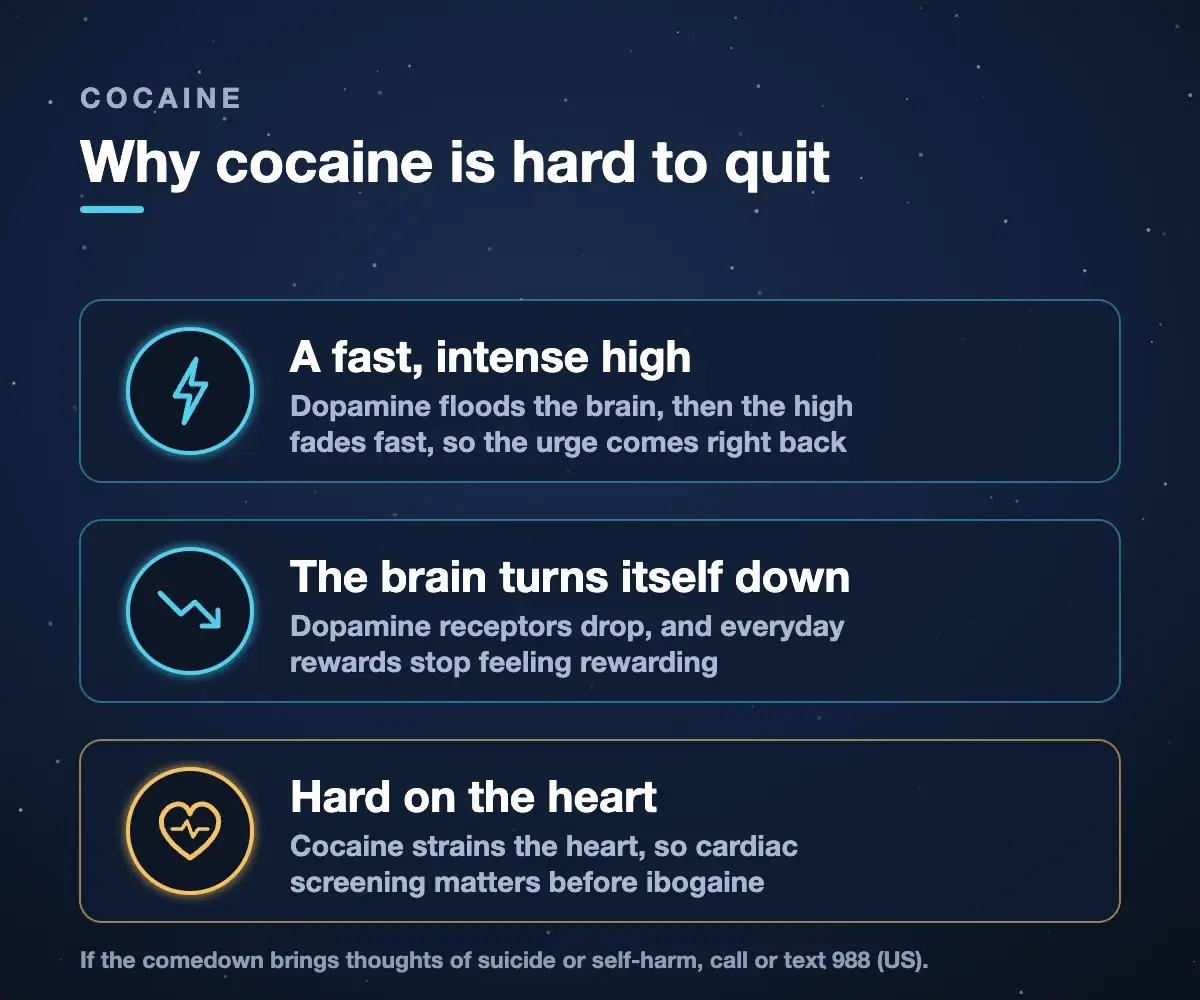
Cocaine hijacks one of the most fundamental systems in the brain: the dopamine reward circuit. Every time you use, dopamine floods the brain at levels far beyond what natural rewards produce. The high is short and intense, and that short duration is part of what makes cocaine so compulsive. The comedown hits fast, and the brain learns one lesson very efficiently: do that again.
Over time, the brain adapts. Dopamine receptors are downregulated and natural production drops, so the reward system that’s supposed to make food, connection, achievement and rest feel meaningful becomes blunted. That’s why the comedown and the weeks after can feel so flat, and why cravings keep pulling you back.
Talk therapy and group counseling help with the emotional and behavioral side, but the dopamine system itself can take months to recover, and unlike opiate addiction, there’s no approved medication for cocaine addiction. Relapse is common, not because people lack willpower, but because the brain needs time to heal.
Since opening in 2018, Iboga Treatment Center has focused on longer stays, and our cocaine rehab in Ensenada, Mexico follows the same idea: enough time for your brain to start recovering.
THE SCIENCE
How Ibogaine Treats Cocaine Addiction
Ibogaine reaches several parts of the brain together, among them the dopamine and serotonin transporters cocaine acts on, along with NMDA and opioid receptors. Lab animals given ibogaine or related compounds took less cocaine when they had the chance. First time reading about ibogaine? Start with what ibogaine is and how it works.
For cocaine-dependent guests, the flood dose often works on two levels at once: the pull of a worn-down reward system, and the psychological patterns that drive compulsive use. Afterward, guests frequently describe more even moods, fewer cravings and sharper thinking, during weeks when the brain may be especially receptive to change.
The human research is still early, and we want to be straightforward about it. A 2014 study from Brazil followed 75 people treated with ibogaine, most of whom had used cocaine or crack, and 61% reported being abstinent at follow-up. It had no control group and relied on self-report, and there are still no published controlled trials of ibogaine for cocaine. Ibogaine is not a one-and-done cure: the smaller iboga sessions, counseling, nutrition and structure in the weeks that follow are what allow recovery to take hold.
WHY IBOGAINE
A Different Kind of Cocaine Rehab
Many people who come to us for cocaine have already tried a 28-day program, outpatient treatment, therapy, or AA and NA, and felt fine for a few weeks before the low mood and emptiness set in. Ibogaine is aimed at that part of the problem. We’re an ibogaine treatment clinic in Mexico designed around longer stays, so ibogaine comes with the time and support your brain needs to rebuild.
Cocaine Withdrawal Timeline, With and Without Ibogaine
Cocaine withdrawal usually isn’t physically dangerous the way alcohol withdrawal can be, but the comedown and the weeks of low mood that follow are where many people relapse. Below is what a cocaine comedown usually looks like, compared with how we manage it.
Without Ibogaine
On your own
Days 1–3
The crash, or comedown. Extreme fatigue, deep depression, increased appetite, agitation and long, heavy sleep. The body and brain are exhausted from the binge.
Days 4–10
Acute withdrawal. Anhedonia, irritability, brain fog, restlessness and intense cravings. Sleep is heavy and unrefreshing. Many people relapse here.
Weeks 2–8
Post-acute withdrawal sets in: persistent low mood, lack of motivation, trouble feeling pleasure and unpredictable cravings, often triggered by the smallest reminders. Many people describe this as the hardest stage.
Months 3–12+
Recovery is slow and uneven. Thinking gradually improves, but the dopamine system can stay blunted for months, and relapse risk stays high without structured support.
With Ibogaine Under Medical Care
Our approach
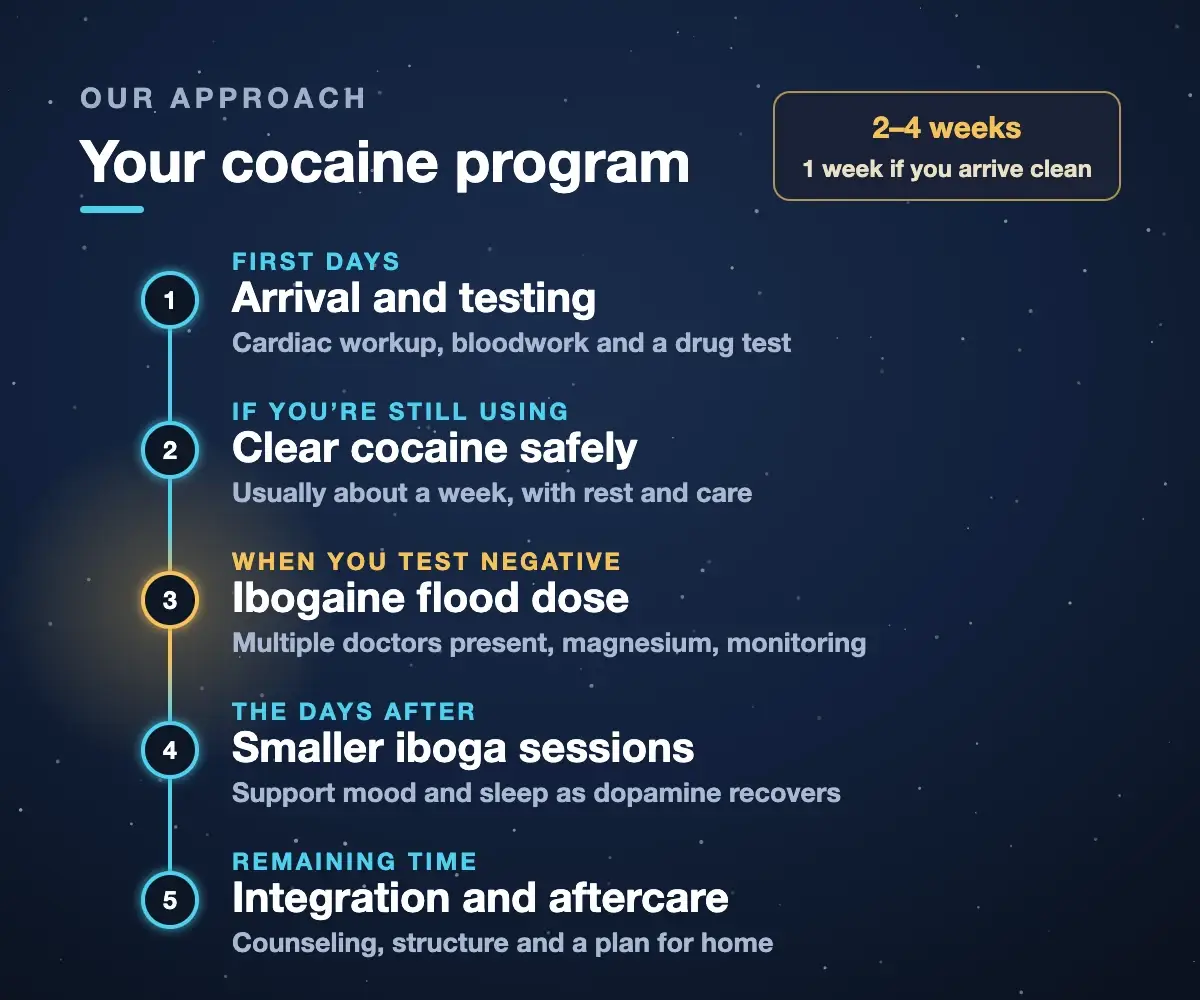
Arrival and testing
A full medical and psychological evaluation, a cardiac workup, bloodwork and a drug test. Long-term cocaine use can stress the heart, so this phase is especially thorough.
Cocaine detox (if needed)
If you arrive still using, we help you through the comedown with rest, nutrition, medical care and daily counseling until you test negative, usually about a week. Medical staff are on site 24/7.
Flood dose
After a negative drug test and medical clearance, you receive the flood dose, with several doctors present, magnesium alongside the ibogaine and heart monitoring for the full 24 to 36 hours.
The days after
Smaller iboga sessions support mood and sleep as your dopamine system comes back online. Many guests notice pleasure in everyday things again.
Remaining time
Integration therapy, daily counseling with licensed counselors, structure and residential support.
When you leave
A written aftercare plan for home, with supervised housing available if you want a longer stay.
These are typical ranges, and your own timing may differ. Our medical team decides your exact schedule. If the comedown ever brings thoughts of suicide or self-harm, call or text 988 (Suicide & Crisis Lifeline, US) right away.
HOW TO QUIT COCAINE
How to Quit Cocaine Safely
Cocaine withdrawal usually isn’t life-threatening on its own, but the comedown can bring severe depression, exhaustion and intense cravings, and for some people thoughts of suicide. Trying to push through alone is where many people relapse, and medical and emotional support in the first weeks makes a real difference.
Our approach: you don’t have to be clean before you arrive. If you’re still using, our medical team supports you through the comedown and cocaine detox until you test negative, usually about a week. Because cocaine and ibogaine both affect the heart, we only give ibogaine once you test negative. The ibogaine session comes next, under continuous heart monitoring with several doctors in attendance, and it’s followed by low-dose iboga, counseling and a structured routine while your brain recovers.
Please tell us everything you’ve been using. Fentanyl has turned up in the cocaine supply, and if there’s any chance you’ve been exposed, it changes how we detox you. Learn how we get you ready on our page about what happens before ibogaine treatment.
How Long Is Cocaine Rehab With Ibogaine?
1 week
If you arrive clean and test negative
2+ weeks
If you’re still using, since cocaine detox takes about a week
2–4 weeks
What we recommend, so your brain has time to recover
It depends on whether cocaine is already out of your system when you arrive. For your safety, we only give ibogaine once you test negative. Compare our ibogaine treatment programs.
The Iboga Treatment Center Cocaine Protocol
Screening and Testing
Before your ibogaine session, our medical team runs a full evaluation: a cardiac workup with an EKG, a complete blood panel, kidney and liver function tests and a psychological assessment. Long-term cocaine use is hard on the heart, and ibogaine has its own cardiac considerations, so cocaine must be completely out of your system first. We only give ibogaine once you test negative.
The Ibogaine Session
The flood dose is given in a fully equipped medical room, and your heart is monitored the entire time. Several doctors attend, you receive magnesium with the ibogaine, and staff stay at your bedside through the 24 to 36 hours it lasts. Three physicians on our staff direct your care.
Post-Flood Iboga Work
After the flood dose, smaller iboga sessions support your continued healing and ease lingering cravings and low mood. This phase matters for cocaine guests, because the dopamine system needs time to come back online. We use a similar approach for meth addiction.
Integration and Aftercare
Each day, a licensed counselor helps you work through what surfaced, spot your triggers and practice ways of coping at home. Before you go home, we write your aftercare plan together, and you can stay longer in supervised housing through extended aftercare.
GUEST STORY
Jason’s Story
“I started using cocaine in my late twenties. Nothing dramatic at first — bumps at parties, work events, weekends with the right people. I was running my own company. I had it all together, or thought I did. By thirty-five I was using almost every day, alone, in my office. Nobody knew. That’s the thing about cocaine — you can hide it for a long time.
I tried to stop on my own probably twenty times. I’d go a week, two weeks, a month. Then something would trigger it — a stressful meeting, a flight, a bad day — and I’d be right back. I went to outpatient therapy. I tried AA. I did a 30-day rehab in Arizona that cost a fortune. I’d come out feeling clear and committed, and within six weeks I’d be back to using. I started to think this was just who I was now.
I came to Iboga Treatment Center because I was out of ideas. I told my wife I’d give it one more try. I did the 30-day program. The first week was harder than I expected — I think my body was finally crashing the way it should have crashed years ago. The medical team kept me steady through it.
The flood dose was unlike anything I can describe. I saw my life from outside myself. I saw why I’d been using. I saw the pressure I’d been putting on myself for thirty years. I saw the shame. I saw the way I’d been using cocaine to outrun my own anxiety. None of that was new information exactly — but feeling it that clearly, in one session, was something else.
The weeks after were the part that really changed things. I stopped wanting it. Not in a “white-knuckling it” way — I just stopped wanting it. The constant pull was gone. I started sleeping. I started feeling things I hadn’t felt in years.
I’ve been clean for sixteen months. I’m running my company better than I ever have. My marriage is back. My kids notice. I’m not the same person who walked into that clinic, and I mean that in the most literal way.”
Individual results vary. See more guest experiences on our testimonials page.
Cocaine Rehab and Ibogaine: Your Questions Answered
Is ibogaine safe for someone who’s used cocaine long-term?
Ibogaine is not without risk, particularly for the heart, and it should be given only after thorough screening and under continuous medical monitoring. Long-term cocaine use can also strain the cardiovascular system, so every guest receives a cardiac workup, a complete blood panel and a psychological assessment before treatment, and cocaine must be completely out of your system first: we only give ibogaine once you test negative. While you’re in the session, more than one doctor is present, magnesium goes in with the ibogaine and your vital signs are tracked nonstop. If a heart condition or medication rules ibogaine out for you, we’ll tell you so honestly. For the full picture, read Is Ibogaine Safe? The Honest Answer.
Do I need to stop using cocaine before coming to the clinic?
No. Many guests arrive still using, and we help them clear it here, which usually takes about a week. If you can arrive clean and test negative, we can start treatment sooner and your stay can be shorter. Don’t stop drinking or prescribed medications on your own, though, because withdrawal from some of them can be dangerous, so talk to us first. Please tell us everything you’ve been using: fentanyl has turned up in the cocaine supply, and many overdose deaths involving cocaine also involve opioids. If there’s any chance you’ve been exposed, knowingly or not, it changes how we detox you. We also treat fentanyl addiction.
What is the cocaine comedown like?
The comedown, or crash, usually starts within hours of the last use and can last several days. Common symptoms are exhaustion, long sleep, low mood or depression, irritability, anxiety, increased appetite and strong cravings. It usually isn’t physically dangerous, but the low mood can be severe. If it brings thoughts of suicide or self-harm, call or text 988 (US) right away. At our clinic, medical staff support you through it before ibogaine is given.
How long does cocaine withdrawal last?
The crash typically lasts a few days. Acute withdrawal, with low mood, poor sleep, irritability and cravings, usually eases over one to two weeks. Low mood and cravings can come back in waves for weeks or months afterward, which is why the time after the flood dose matters so much.
How does ibogaine help with cocaine specifically?
Cocaine wears down the dopamine system over time, and there’s no approved medication for cocaine addiction the way there is for opiates. Ibogaine acts on the dopamine and serotonin systems, and many guests describe it helping them feel pleasure again in the weeks after treatment. Combined with integration therapy, it gives the brain time and the right conditions to recover. The research is still early, so we’re honest that results vary from person to person.
Will ibogaine help with the depression and anhedonia I feel?
We can’t promise that, but for many cocaine guests the change is noticeable. In the weeks after the flood dose, many describe noticing pleasure in everyday things again — food, conversation, sleep — for the first time in years. Recovery from anhedonia takes time, and low mood can come and go while your brain heals. If depression was part of your life before cocaine, we can address that too — learn more about ibogaine for depression. If you ever have thoughts of suicide or self-harm, call or text 988 (US) right away — and while you’re with us, tell our staff immediately.
I’ve been to rehab multiple times. Why would ibogaine be different?
Rehab works for some people, but many people with cocaine addiction feel fine in early sobriety, then slide back into use weeks or months later when the low mood and emptiness set in. Ibogaine is aimed at that part of the problem. It’s not a miracle, and results vary, but many guests describe it as the difference between white-knuckling sobriety and actually feeling okay without cocaine.
How long should I stay for cocaine rehab?
It depends on whether cocaine is already out of your system when you arrive. For your safety, we only give ibogaine once you test negative. Guests who arrive clean may need as little as one week. If you’re still using, clearing cocaine usually takes about a week here, so plan on at least two weeks. Either way, we recommend two to four weeks if you can manage it, so your brain has time to recover before you go home. See our program options.
Can I do ibogaine treatment if I also drink or use other substances?
Yes. Many people who use cocaine also drink, and some use other substances too. Using cocaine and alcohol together creates cocaethylene, a compound that’s harder on the heart than cocaine alone, so tell us about everything you use. Our evaluation accounts for everything in your system, and our medical team builds a stabilization plan around your full picture, not just the cocaine. We also treat alcohol addiction.
How much does cocaine rehab cost?
Your cost comes down to program length and medical needs, including any days needed to clear cocaine first. Admissions shares pricing with you once screening is complete. General pricing is explained on our ibogaine treatment cost page.
How do I get from San Diego to the clinic?
Our clinic sits in Ensenada, in Baja California, around two hours by car from San Diego. Book a flight to San Diego International; we’ll collect you at the airport and drive you across the border to the clinic. Our admissions team helps you plan the trip and explains what to pack. Ibogaine is Schedule I in the US, so it can’t legally be offered there; that’s why our clinic operates in Mexico.
Still have questions? Call admissions at (877) 876-4157.
Ibogaine Treatment for Other Substances
Another stimulant that wears down the dopamine system. See how our meth program works.
Prescription stimulants can be just as hard to quit. See how our Adderall program works.
Cocaine and alcohol often go together. See how our alcohol program works, with medical detox first.
Our ibogaine addiction treatment page covers every substance we treat.
Ready to Break Free From Cocaine?
Call us for a free, confidential conversation about cocaine treatment. You’ll get straight answers, never a hard sell.